
Email archive licensing: what a hold changes
Email archive licensing starts with a preservation question. If a mailbox sits under a litigation hold, the provider will not let you purge it. An unlimited hold keeps everything until someone lifts it. That helps completeness and hurts control. Check the hold state, the retention policy and whether deleted mail is still recoverable before anyone discusses value. This is a checklist, not legal advice.
By Sell My Company DataPublished 1 November 2026
No files needed to start
- Sources
- 3 primary sources
- Reading time
- About 2 min
- What this adds
- A preservation state table that maps three mailbox conditions to what an export will and will not contain. It also lists the export settings that carry value: threading, headers and attachments. An owner can answer a buyer's first question from this page without a lawyer present.
What a hold does to an archive
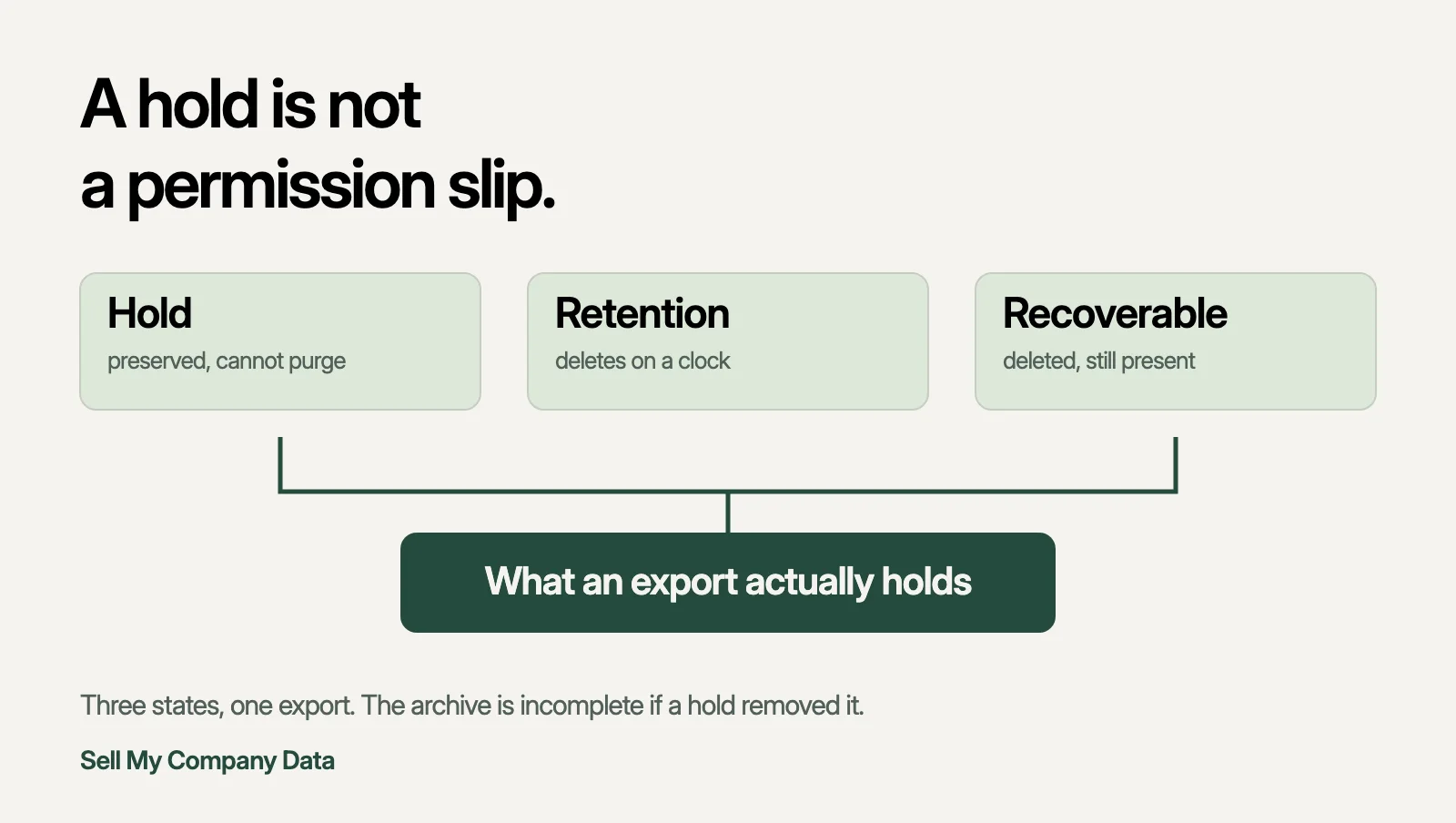
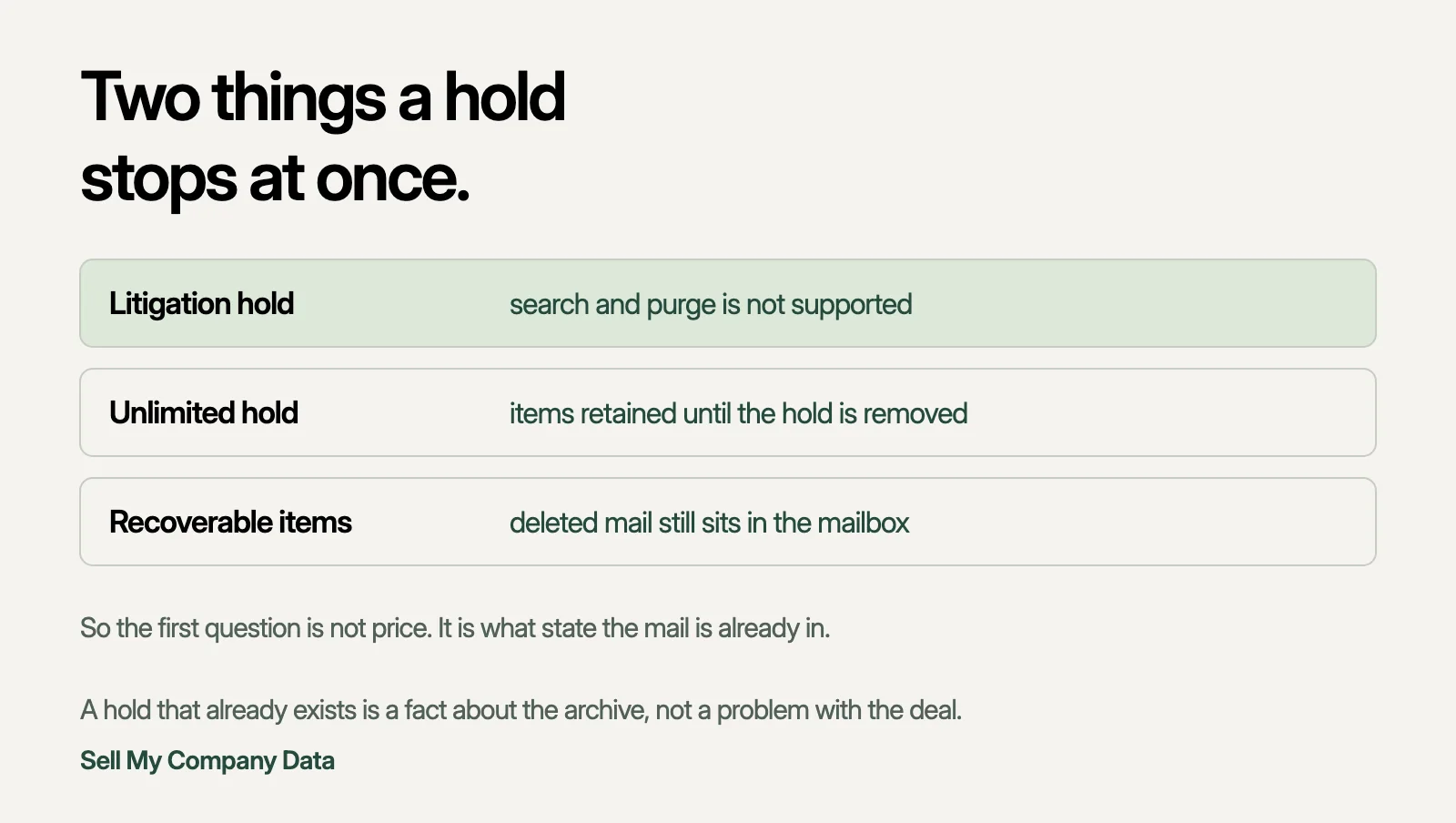
A litigation hold is an instruction to preserve. It is not a ruling on ownership. It is not evidence that something went wrong. Microsoft states the effect plainly: search and purge is not supported if a mailbox has a litigation hold. The same protection that guards a company in a dispute also decides what an export can contain.
Duration matters as much as the hold itself. Where a hold has no end date, items are retained until the hold is removed. The archive becomes safer and less controllable at once.
Deleted mail is the third state. Messages that a user removed can still sit in recoverable storage for the period your organisation set. An export that reads live mailboxes only will miss them. An export that includes them may hold correspondence the business thought was gone.
Record this before you promise anything
- Which mailboxes are under a hold. Whether that hold has an end date.
- What the retention policy does alone, with no hold in place.
- Whether recoverable items fall inside the scope you intend to describe.
- Who can authorise a change to any of the above, in writing.
What an export actually contains
A buyer is not paying for message count. Google's definition of the unit is instructive: a thread is a collection of related messages forming a conversation. That is the difference between a reasoning record and a pile of text.
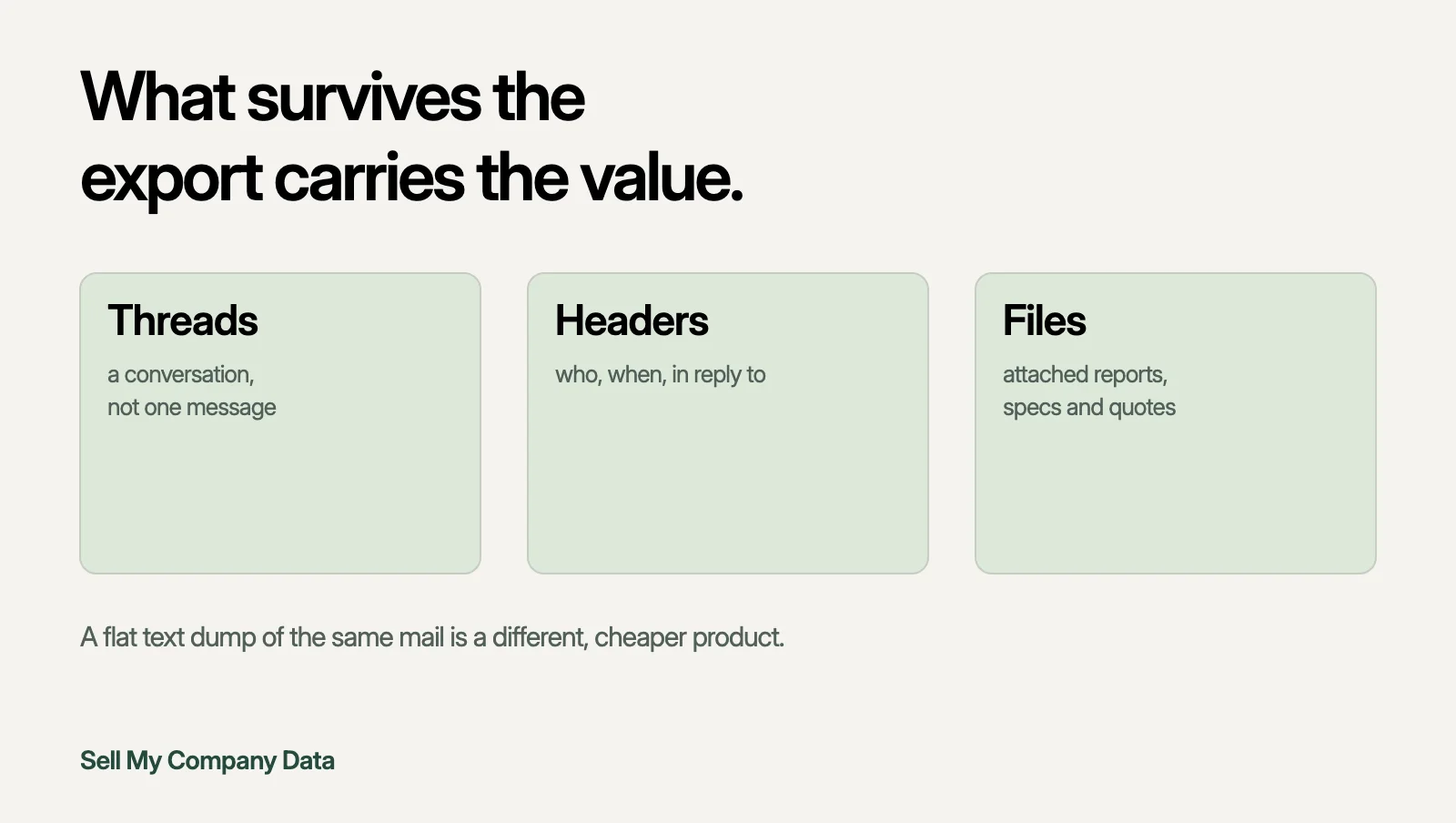
Three properties carry most of the value. A careless export loses all of them.
- Threading. A conversation shows a decision argued, revised and settled. One message shows an assertion.
- Headers. Sender, recipient, timestamp and reply links let a buyer rebuild sequence and roles.
- Attachments. Specifications, quotes and reports are often the operational content the mail merely carried.
An export built for migration tends to flatten these. Ask for an export built for review instead.
The personal data question, in order
Email holds personal data. That does not end the conversation. It sets the sequence. The UK GDPR requires data to be collected for specified, explicit and legitimate purposes and not further processed in an incompatible way. That is purpose limitation. Licensing for training is a new purpose.
A purpose recorded at collection does not stretch to cover it. Someone with authority over the data has to identify a lawful basis for the new use and write it down.
A sequence that survives review
- Describe the archive: mailbox count, year range, systems, languages.
- State the hold and retention position honestly, gaps included.
- Name the personal data categories present, without exporting a sample.
- Record who inside the business can approve the new purpose.
- Only then discuss scope with a buyer.
De-identification is a buyer-side step carried out at their cost. It follows scope. It never replaces it.
What to send, and what not to
The first document a buyer receives should describe the archive. It should not be the archive. Send counts, date ranges, systems and the preservation position. Hold the export until scope, purpose and permission are agreed in writing.
Two habits prevent most problems. Keep a dated record of what you sent. Name one person who can approve a change, because an archive that two departments believe they control is the one that stalls.
If a hold exists, say so at the start. It is common and explainable. A buyer who learns about it late reads the whole file differently.
Sources
- Search for and delete email messages in eDiscovery (Microsoft Learn). Checked 1 November 2026. Relevant text: Search and purge isn't supported if a mailbox has a litigation hold.
- UK GDPR Article 5, principles relating to processing of personal data (legislation.gov.uk). Checked 1 November 2026. Relevant text: adequate, relevant and limited to what is necessary in relation to the purposes for which they are processed
- Gmail API guides (Google for Developers). Checked 1 November 2026. Relevant text: A collection of related messages forming a conversation.
Questions
Does a litigation hold stop me licensing the archive?
Not by itself. A hold preserves material and blocks deletion, so it changes what an export can contain and who can approve a change. It has to be disclosed and worked with, not hidden.
Should the export include deleted email?
Only if you can describe it accurately and approve the scope in writing. Deleted mail that still sits in recoverable storage is part of the archive whether or not it appears in an export, so decide deliberately rather than by export default.
What export format should I ask for?
One that keeps threads, headers and attachments intact. A migration export optimised for mailbox moves usually flattens exactly the structure that carries value.
Who decides whether we can license for training?
Someone with authority over the data, working from a recorded lawful basis for the new purpose. A supplier or IT administrator can export the mail without being able to approve its use.
Is removing personal data our job?
No. Buyers de-identify as part of their intake, at their own cost. Your job is to identify the categories present and to agree scope before anything leaves the business.