
Accounting data licensing: the statutory floor
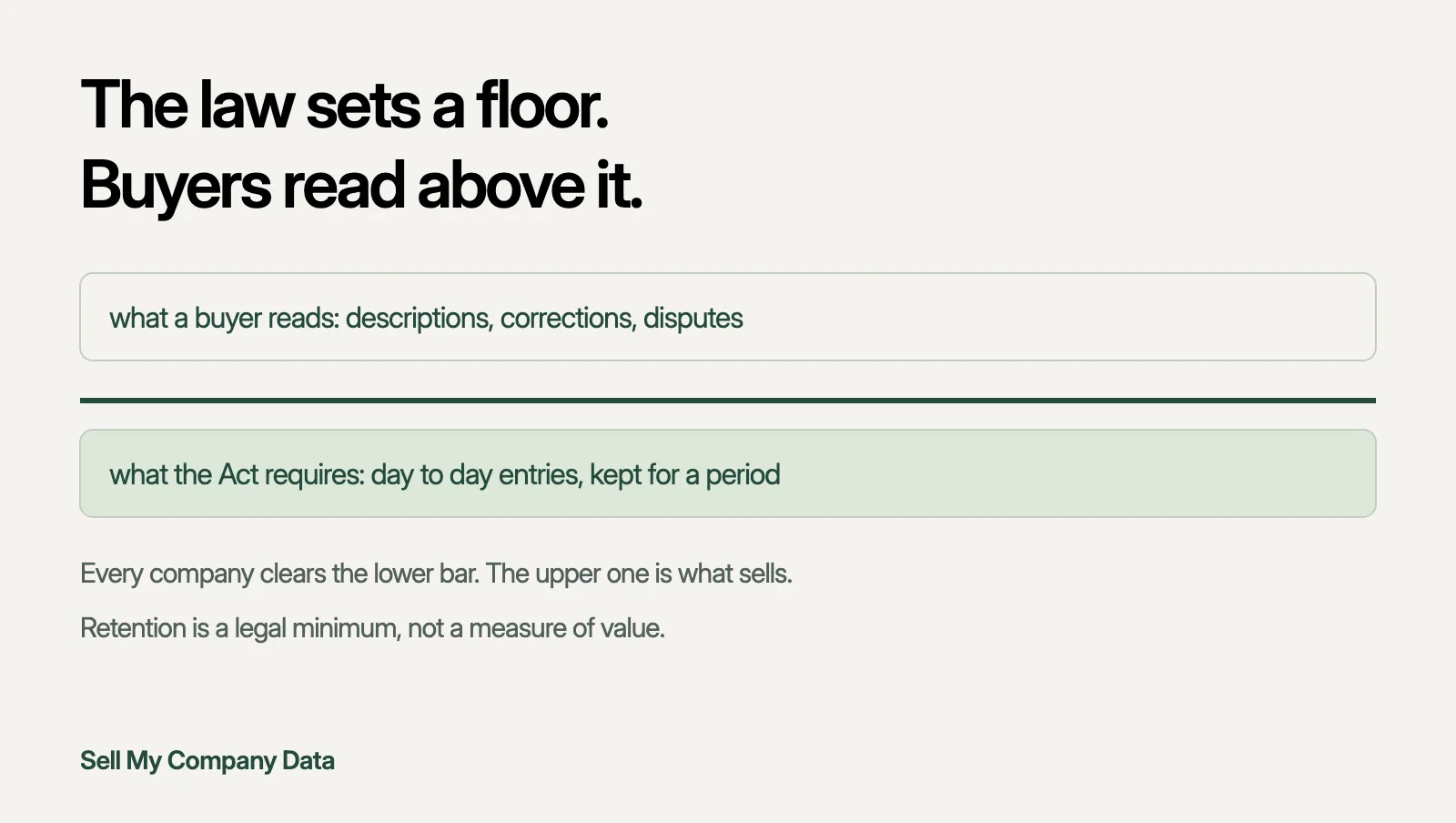
Accounting data licensing is not about totals. The law already covers those. Section 386 of the Companies Act requires day to day entries and the matters in respect of which money moved. Section 388 sets a minimum retention period. A buyer reads a different layer: the description line, the corrections and who was paid. Keep that, not just the summary.
By Sell My Company DataPublished 1 November 2026
No files needed to start
- Sources
- 3 primary sources
- Reading time
- About 2 min
- What this adds
- A three layer map of an accounting estate: the statutory minimum, the working record a buyer reads, plus the fields that vanish in a totals only export. It also flags the retention trap, where a lawful purge can destroy the depth a buyer needs before any conversation starts.
What the law already covers
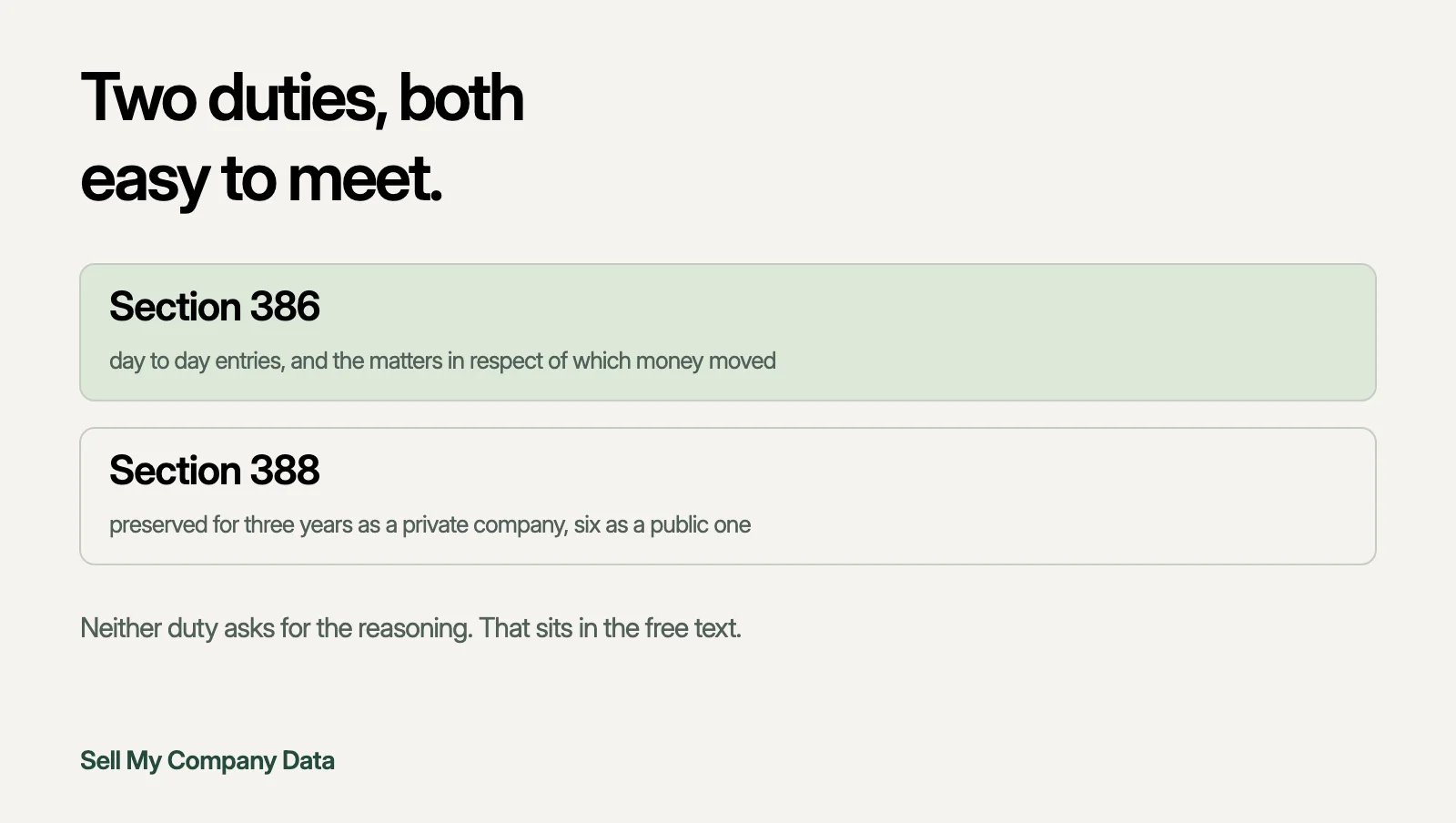
Start with the floor, because most owners confuse it with the asset. Section 386 sets it. The company must keep entries from day to day of all sums of money received and expended. It must also record the matters in respect of which the receipt and expenditure takes place.
Section 388 then sets how long the record must survive. It must be preserved in the case of a private company, for three years from the date on which they are made. A public company must keep its records for six years.
Neither duty asks for reasoning. The Act wants proof that money moved, between identifiable parties, for a stated reason. It does not ask why the price changed, or what was done when the invoice was disputed.
What a buyer reads instead
A general ledger is a register of debit and credit entries. That definition is accurate and also the reason a bare export disappoints. A register records that something happened.
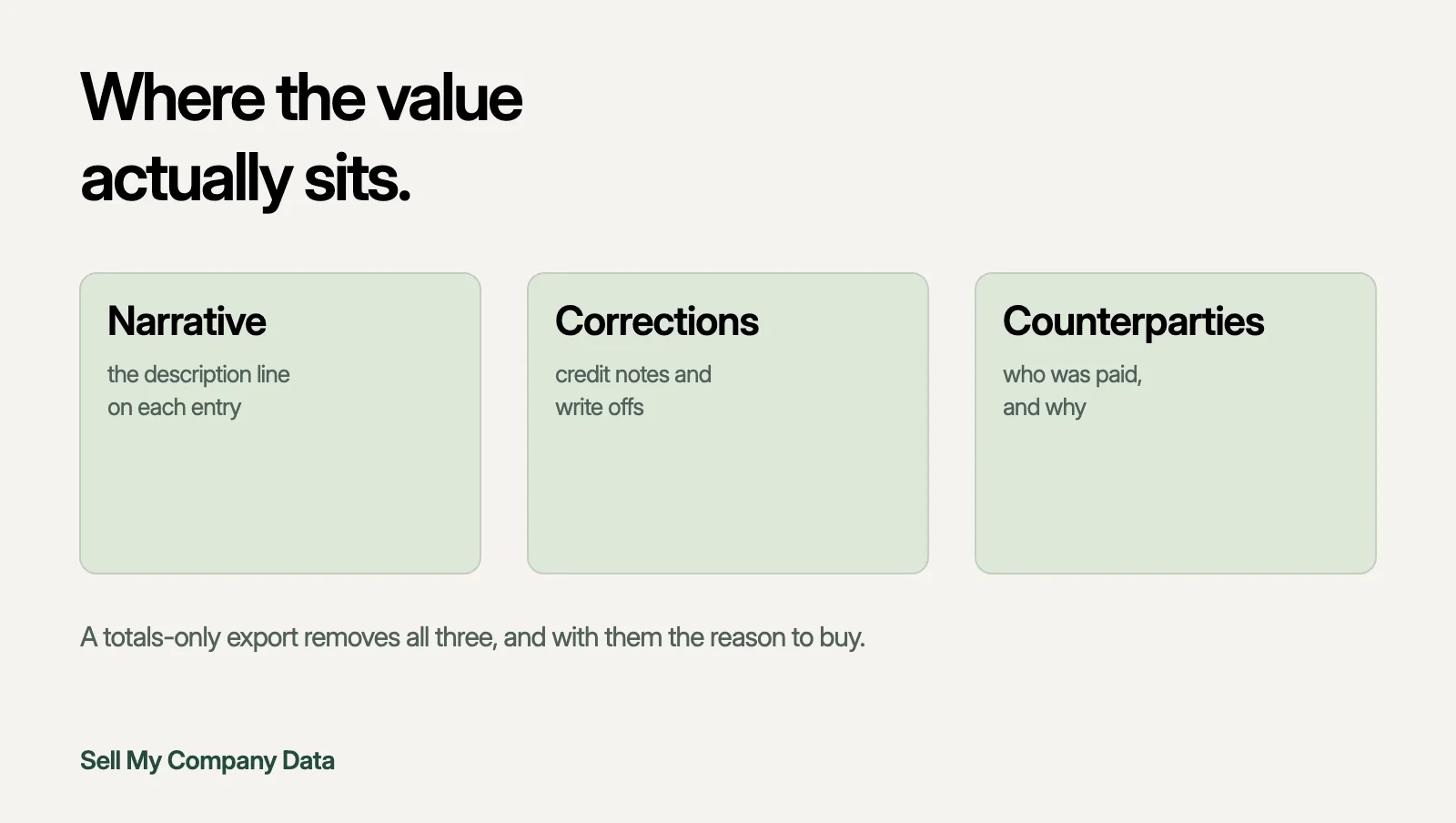
Three fields carry the value. All three are optional in practice.
- The narrative. The description line on each entry. It is the only place a human explains what the transaction was for.
- The corrections. Credit notes, write offs, reissued invoices. A record that shows a mistake and its fix is a reasoning chain.
- The counterparties. Who was paid, on what terms. What happened when the terms slipped.
A totals only export is a statutory account with extra steps. The narrative is what makes the same ledger licensable.
The retention trap
The company law minimum and the buyer's interest point in opposite directions. Three years is the floor for a private company. It is also short. Tax retention rules commonly require longer, so the floor is never a licence to delete at year three. Most buyers want several consecutive years, because depth is what shows a business adapting.
A business that has purged at the company law minimum may have removed exactly the material a buyer would price. That does not breach the Companies Act. It still changes what the archive can support.
Practical order of operations
- Check what still exists before describing it as an asset.
- Pause routine purge once a conversation is live. Record the pause.
- Describe the years you actually hold, not the years the business has traded.
- Name who can approve a change to retention, in writing, after checking every duty that applies.
What to send first
Send a description, not a file. Name the system and the years covered. Give roughly how many transactions. Say whether line items and narratives export together. Say whether the ledger is reconciled. That is enough to price the archive or to say what is missing.
Two details decide most conversations. Whether the export keeps the description field at all. Whether it includes the correction trail. A system that produces both is worth more than one that produces neither, at identical headcount and years.
Excluded from every scope: customer and consumer personal data, payroll records and payment card data. A large invoice count does not make those sellable.
Sources
- Companies Act 2006, section 386 (legislation.gov.uk). Checked 1 November 2026. Relevant text: entries from day to day of all sums of money received and expended by the company and the matters in respect of which the receipt and expenditure takes place
- Companies Act 2006, section 388 (legislation.gov.uk). Checked 1 November 2026. Relevant text: in the case of a private company, for three years from the date on which they are made
- General ledger home page (Microsoft Learn). Checked 1 November 2026. Relevant text: The general ledger is a register of debit and credit entries
Questions
Do I have to keep records longer than the Act requires to license them?
Company law sets a minimum. Tax retention rules are usually longer. They apply whether or not you license anything, so check both before deleting. Longer records are worth more because a buyer wants consecutive years of the same system.
Is a trial balance or statutory account enough?
No. Those are summaries. The licensable layer is the transaction record underneath, especially the description on each line and the corrections.
Does licensing affect the audit or the accounts?
No. A licence is a copy for training use. The originals stay with the business and the filings are unaffected.
Which system matters?
Depth of line items matters more than the brand. Xero, QuickBooks and a full ERP can all export something usable. The question is whether the description and correction trail survive the export.
What about a company that is closing?
Complete final records are valuable and time sensitive. The window closes when the systems are switched off, so start before the shutdown rather than after it.