
CRM contact data licensing: who must be told
CRM contact data is personal data about customers, leads and staff of other firms. Your company collected it for its own dealings. A buyer who receives it from you did not collect it from those people. UK GDPR then requires that buyer to tell them, usually within a month. Check your privacy notice and the CRM fields before you describe the archive to anyone.
By Sell My Company DataPublished 14 November 2026
No files needed to start
- Sources
- 4 primary sources
- Reading time
- About 3 min
- What this adds
- A CRM field audit table. It lists the usual fields in a contact export, says what each reveals about a person and gives the minimum check before the archive is described to a buyer.
A CRM is a list of people, not just a list of accounts
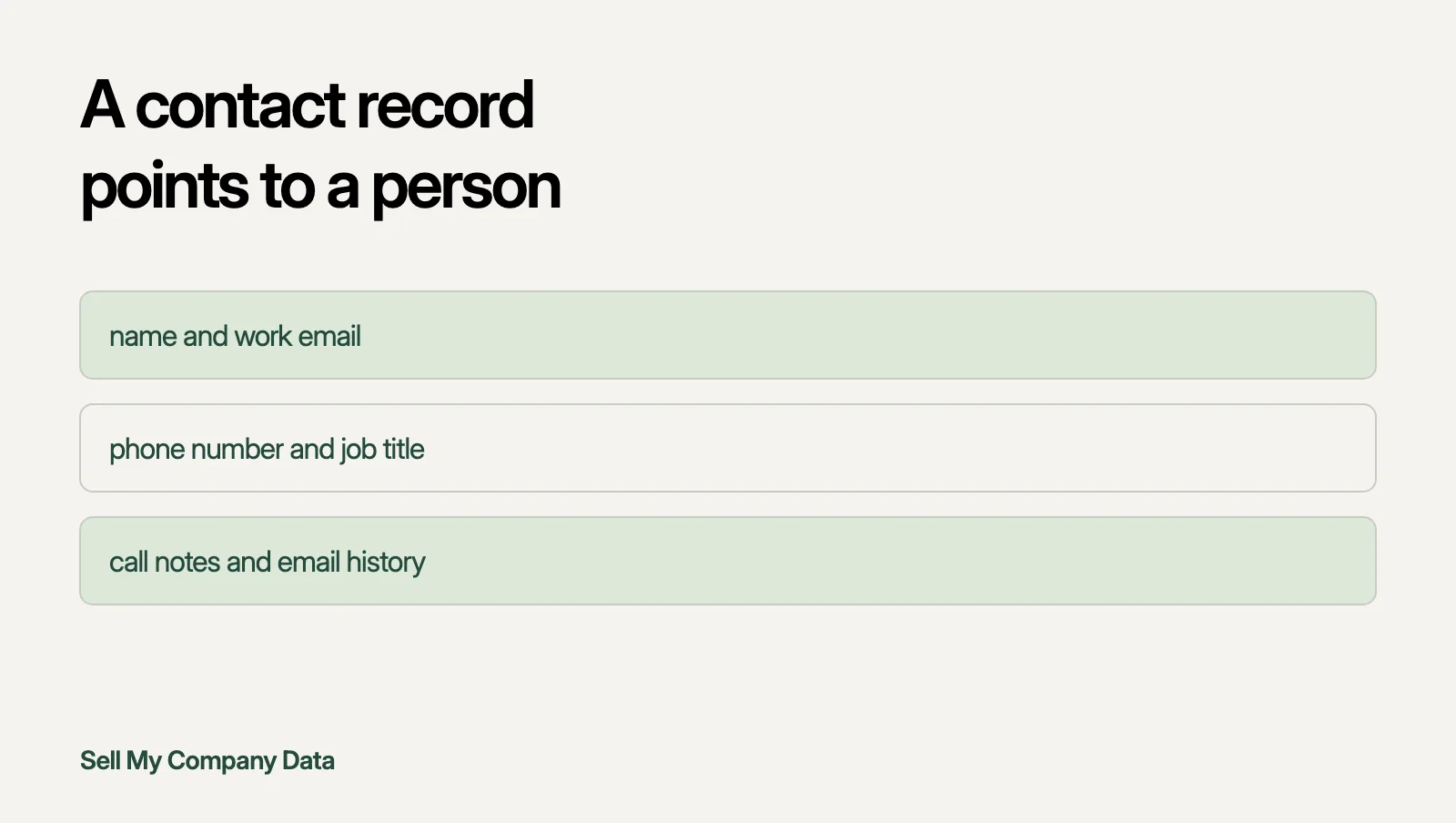
Sales teams think of a CRM as accounts and deals. The law reads it differently. The UK GDPR defines personal data as any information relating to an identified or identifiable natural person. A contact record holds a named person, a work email, a phone number and often notes on what that person said or wanted.
A business contact is still a person. A work email address that includes a surname identifies someone. Call notes and email history attached to the record add more about them. So a CRM export is a personal data archive even when every row has a company name next to it.
Staff of customers, leads from events and people who only ever opened an email all sit in the same table. Each group was told something different when the data was collected. Find out what before going further.
The buyer owes those people a notice
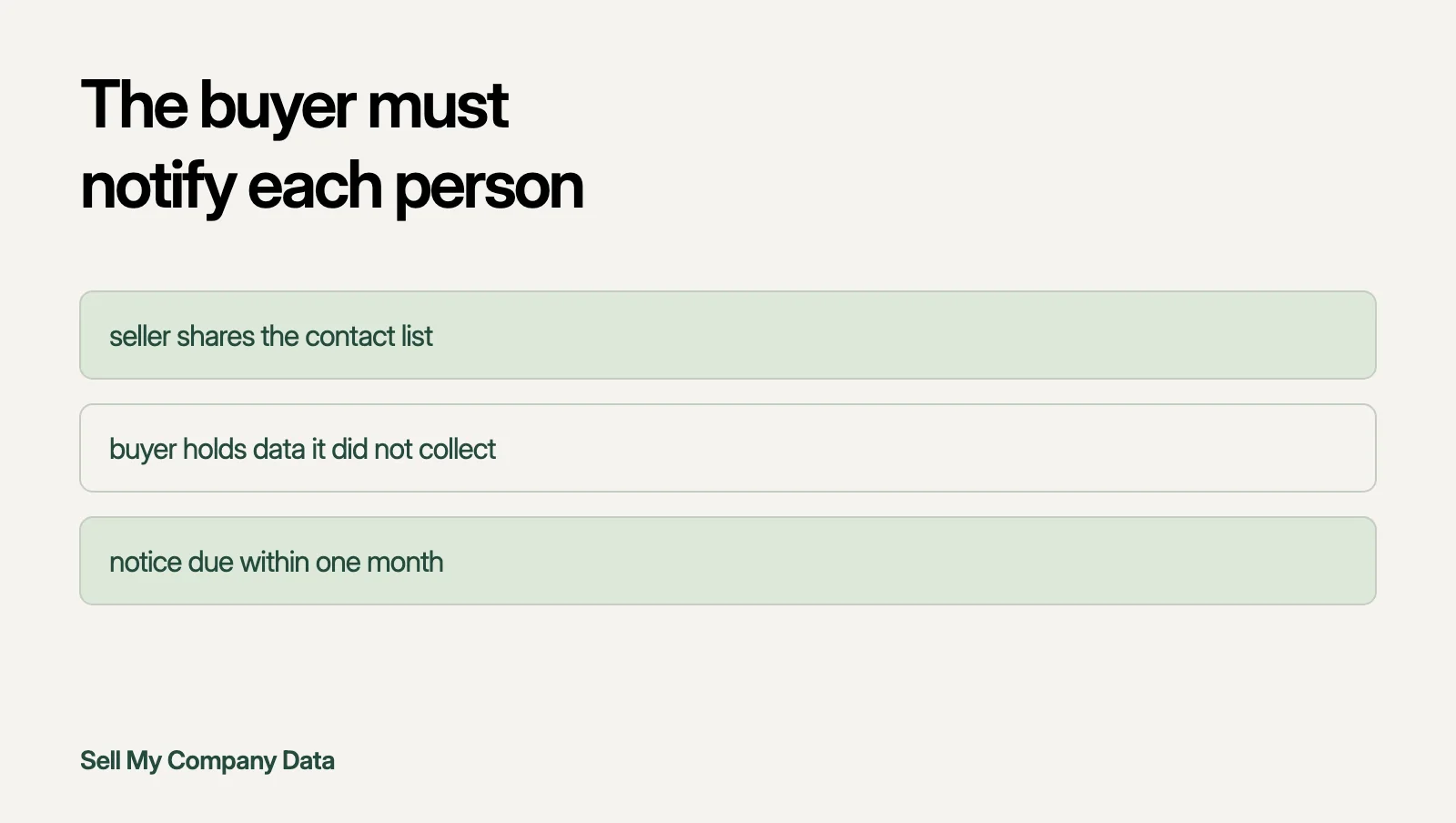
When a company hands contacts to a buyer, the buyer holds data it did not collect from the people concerned. The UK GDPR has a rule for that case. It says where personal data have not been obtained from the data subject, the controller shall provide the data subject with the following information. The list covers who the controller is, why the data is used and the categories of data held.
The same article sets a deadline. The notice must be given within a reasonable period after obtaining the personal data, but at the latest within one month. A buyer that cannot meet that for thousands of contacts has a real problem on delivery day.
This matters to the seller too. Your own notice to those people, under the collection rule, has to list the recipients or categories of recipients of the personal data, if any. If your privacy notice never mentioned data buyers, say so plainly in your notes. A serious buyer will ask.
Legitimate interests is a test, not a pass
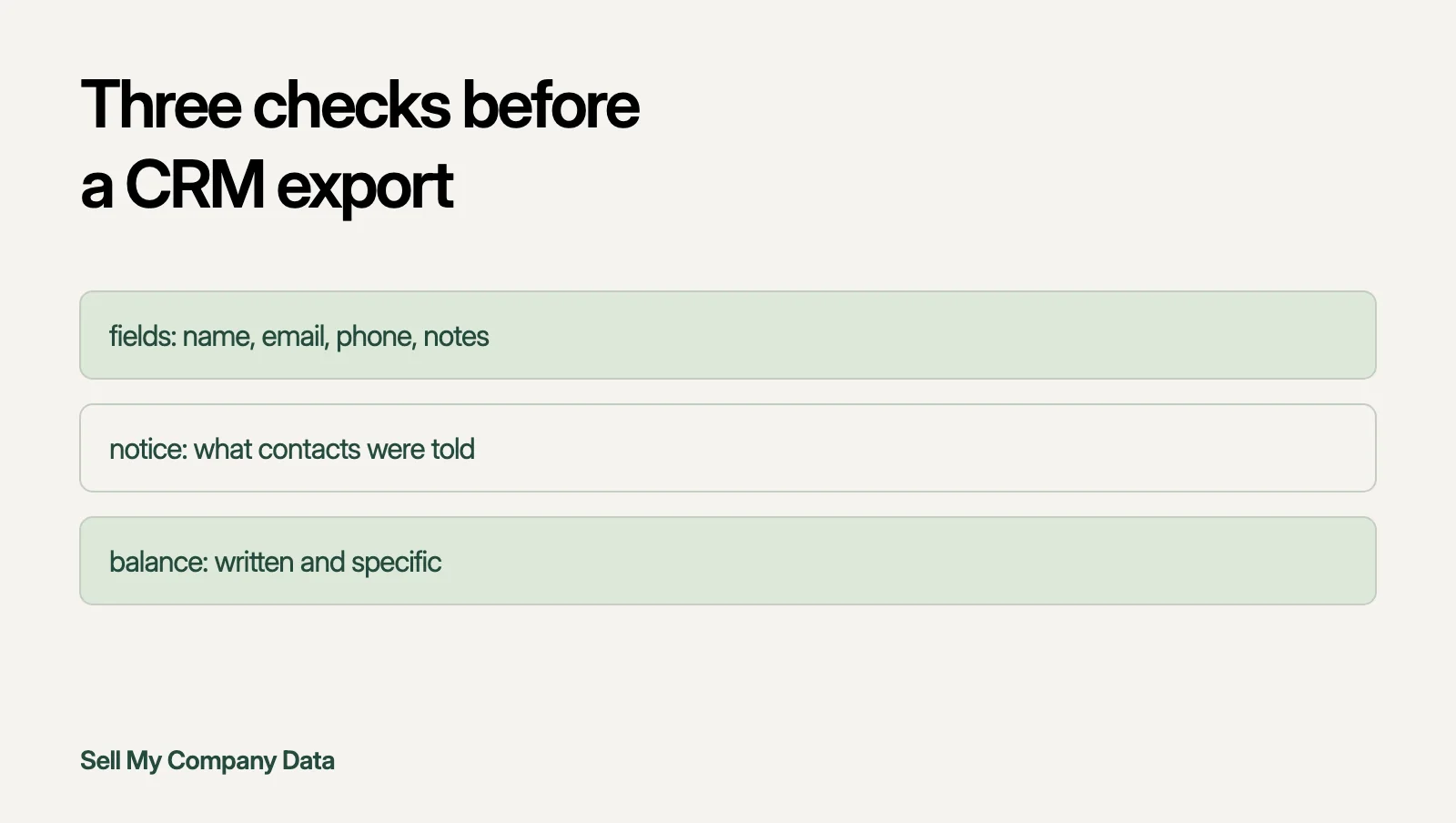
Sellers often assume a business reason is enough. The UK GDPR does list a basis for processing that serves the legitimate interests pursued by the controller or by a third party. It adds an exception: except where such interests are overridden by the interests or fundamental rights and freedoms of the data subject. That is a balancing test. It has to be done and written down for this specific disclosure.
A person who bought a service from you would not obviously expect their details to reach an AI developer. That expectation counts against you in the balance. It does not decide the question alone. It does mean the disclosure needs a reasoned answer before it happens.
Nothing here says a CRM archive can never be licensed. It says the contact fields are where the legal work sits.
Field audit: what each CRM column reveals
Go through your export column by column. Use the table to decide what needs a decision before a buyer sees a description.
| CRM field | What it can reveal | Minimum check |
|---|---|---|
| Contact name and work email | Identifies a person directly | Confirm what the privacy notice told them |
| Phone number and address | Identifies and locates a person | Decide whether the field is needed at all |
| Job title and employer | Narrows a person down with other fields | Treat as identifying when combined |
| Call and meeting notes | Free text about a named person | Read a sample for opinions and private details |
| Email history and attachments | Full correspondence with a person | Leave out unless a reviewer has read it |
| Marketing consent flags | Records what a person agreed to | Keep the consent record with the data |
| Deal stage and value | Commercial terms with a named contact | Check contract confidentiality first |
A field that fails its check is held back. A column you cannot explain is a column you cannot offer.
What a safe first description contains
Describe the archive in plain categories. Give the industry mix, the years covered, the regions, the approximate number of contacts and which field groups are present. Say which fields were left out.
Do not send a sample export. Do not call the set anonymous because the name column is gone. Email, phone and notes can still point to a person.
Keep a short file with your privacy notice, the date it was last changed and the field decisions you made. That file is what a careful buyer asks for first.
Sources
- UK GDPR, Article 4 (legislation.gov.uk). Checked 14 November 2026. Relevant text: any information relating to an identified or identifiable natural person
- UK GDPR, Article 6 (legislation.gov.uk). Checked 14 November 2026. Relevant text: the legitimate interests pursued by the controller or by a third party, except where such interests are overridden by the interests or fundamental rights and freedoms of the data subject
- UK GDPR, Article 13 (legislation.gov.uk). Checked 14 November 2026. Relevant text: the recipients or categories of recipients of the personal data, if any
- UK GDPR, Article 14 (legislation.gov.uk). Checked 14 November 2026. Relevant text: within a reasonable period after obtaining the personal data, but at the latest within one month
Questions
Is CRM contact data personal data?
Usually yes. A named contact with an email address or phone number is an identifiable person, even when the record sits under a company account.
Does a buyer have to tell my contacts it holds their data?
In most cases yes. Where data was not collected from the person, UK GDPR requires the controller to give them specified information within a reasonable period, at the latest one month.
Can I rely on legitimate interests to hand over contacts?
Only after a balancing test that you have written down. The person's interests and expectations can override yours, so the test has to be specific to this disclosure.
Should my privacy notice have mentioned data buyers?
It has to list recipients or categories of recipients. If buyers were never mentioned, record that gap and get advice before you describe the archive.
Is this legal advice?
No. It is general information about UK data protection rules. Have a solicitor review any gap before you rely on it.