
Support ticket data licensing: strip it first
Support tickets are personal data until proven otherwise. A ticket carries a customer's name, email address and often a description of their problem. UK GDPR treats anything that identifies a person, directly or indirectly, as personal data. Deleting the name field is not enough. The ICO says removing direct identifiers alone does not ensure anonymisation. Sort the archive field by field before describing it to any buyer.
By Sell My Company DataPublished 13 November 2026
No files needed to start
- Sources
- 4 primary sources
- Reading time
- About 3 min
- What this adds
- A ticket field audit table. It lists the usual fields in a help desk export, says why each can identify a person and gives the minimum action before the archive is described to a buyer.
A ticket is personal data even without a name
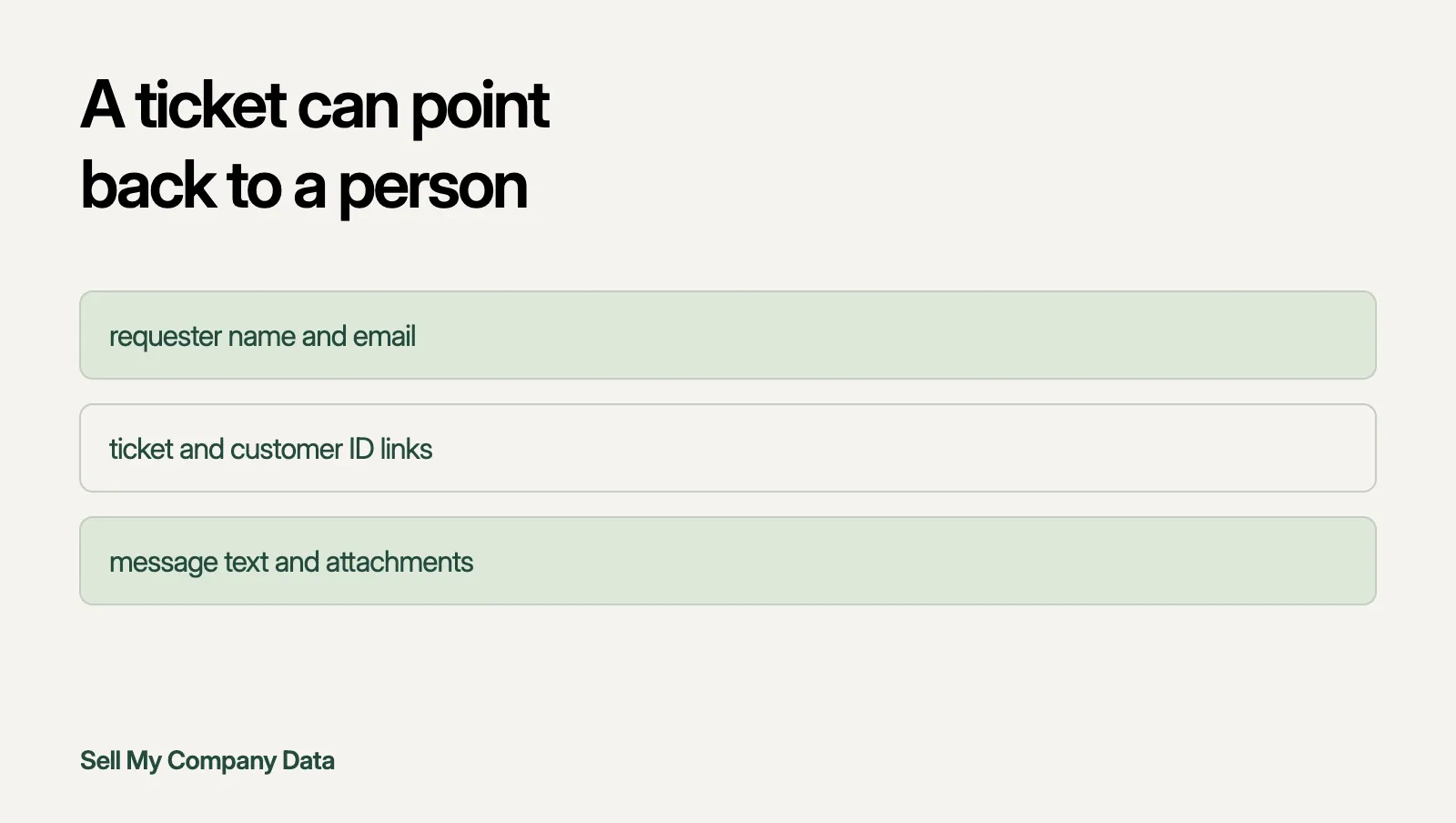
The UK GDPR defines personal data as any information relating to an identified or identifiable natural person. A support ticket usually meets that test on its face. It holds the requester's name and email address. The agent's replies often add an order number, a phone number or a description of something that went wrong for that person.
The test is wider than a name. The same article says a person can be identified directly or indirectly, in particular by reference to an identifier such as an online identifier. A ticket ID that links back to a customer record counts, because the link makes the person identifiable.
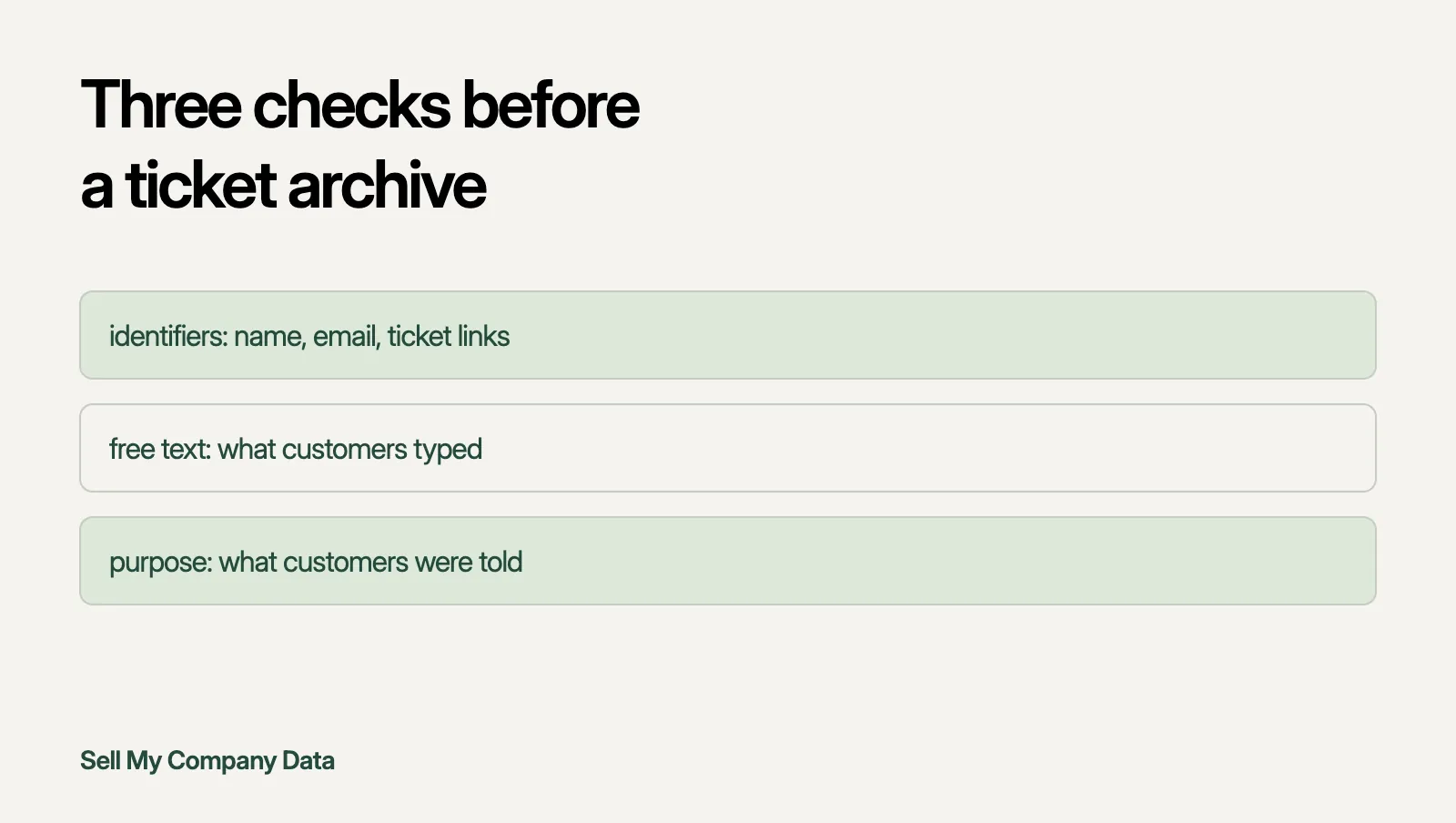
So the starting position is simple. A help desk archive is a personal data archive. Whether any part of it can be offered depends on what you do next. It also depends on what customers were told when they wrote in.
Removing names does not make tickets anonymous
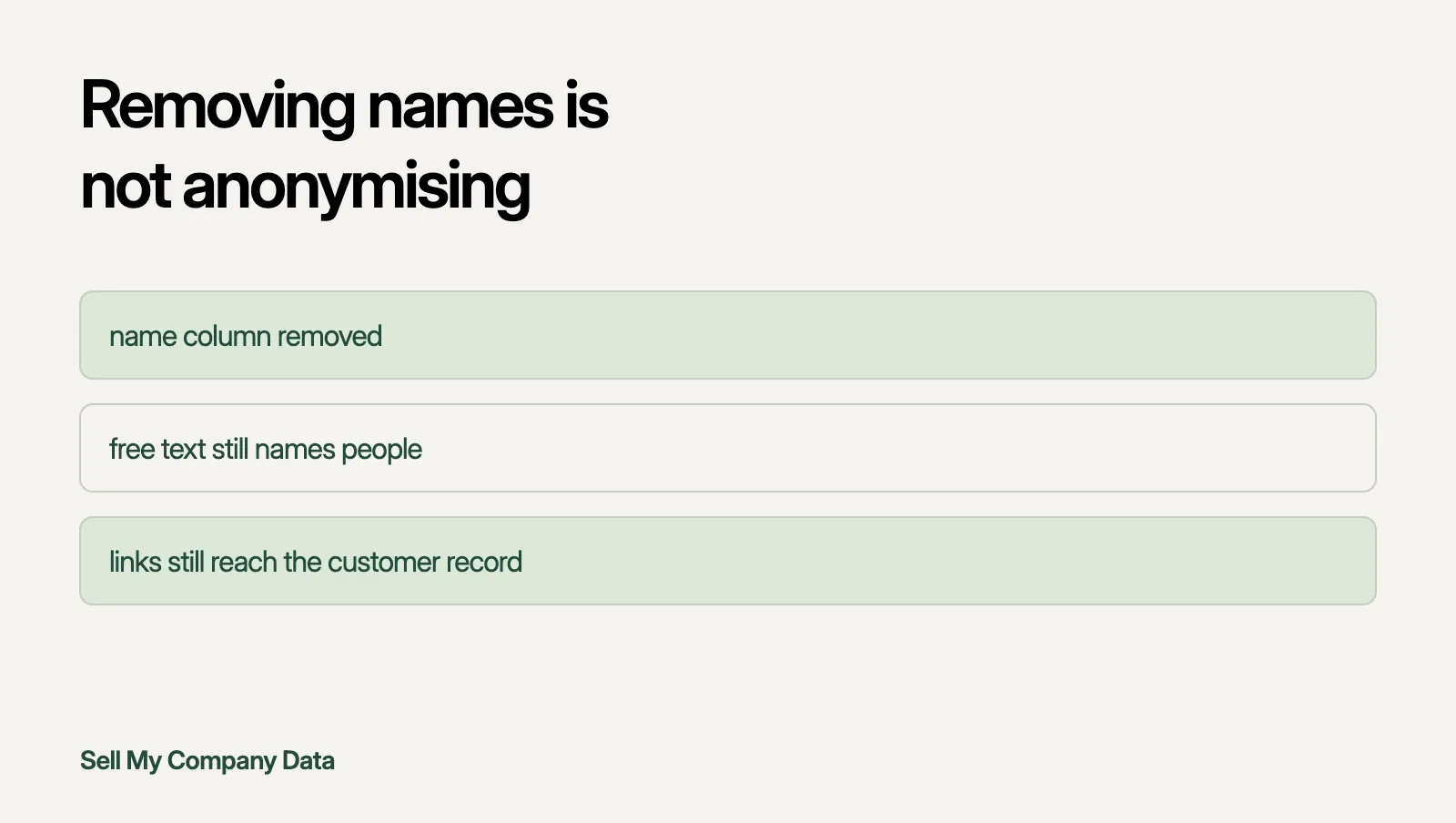
Sellers often plan to strip the name and email columns and call the rest clean. The regulator is direct that this falls short. Its anonymisation guidance says simply removing direct identifiers from a dataset is insufficient to ensure effective anonymisation. It adds that if it is possible to link someone to information in the dataset that relates to them, then the data is personal data.
Tickets are hard cases because most of the content is free text. A customer writes their own address, a colleague's name or a company detail into the message body. The ICO treats unstructured text as needing different techniques from tables of numbers, such as removing direct and indirect identifiers from documents. That means reading samples, not only dropping columns.
The ICO also describes identifiability as a spectrum. It suggests a motivated intruder test as a starting point: could someone determined, with ordinary means, pick out a person from this text? If the honest answer is yes, the archive is still personal data and the purpose rules apply.
Ticket field audit
| Field | Why it can identify someone | Minimum action |
|---|---|---|
| Requester name and email | Direct identifiers | Remove, and keep the removal log |
| Ticket ID and customer ID | Links to a customer record you still hold | Replace with random keys, store the mapping separately or destroy it |
| Message body | Customers write addresses, names and account details in free text | Review a sample, then redact or exclude |
| Attachments and screenshots | Show faces, documents and account screens | Exclude |
| Agent names and notes | Staff are people too | Remove or replace with role labels |
| Timestamps and category tags | Rarely identify alone, but can in a small dataset | Keep, then re-check once the rest is cleaned |
Check purpose before you describe the archive
Tickets were collected to help a customer. The UK GDPR says personal data must be collected for specified, explicit and legitimate purposes and not further processed in a way that is incompatible with those purposes. It also asks for data that is adequate, relevant and limited to what is necessary. Handing a full help desk history to an AI buyer is not obviously within either rule.
If you can truly anonymise a set, the data protection rules stop applying to that set. The work of getting there is itself processing and needs a lawful basis. The ICO's introduction to its guidance says anonymisation is an alternative way to use or share data by making sure that people are not identifiable. Treat that as a result you have to demonstrate, not a label you can apply.
Write down three things: what customers were told, what the cleaning removed and who reviewed a sample. Those notes are what a careful buyer asks for first.
What a safe first description contains
Describe the archive in plain counts and categories. Give the product area, the years covered, the language, the approximate number of tickets and whether resolution outcomes are recorded. Say which fields were removed and which remain.
Do not send a sample until a reviewer has read it for names, addresses and account numbers inside the message text. Do not call the archive anonymous. Say what was removed and leave the legal label to someone qualified to give it.
If the cleaning cannot be shown, hold the archive back. A smaller set you can explain is easier to offer than a larger one you cannot.
Sources
- UK GDPR, Article 4 (legislation.gov.uk). Checked 13 November 2026. Relevant text: any information relating to an identified or identifiable natural person
- UK GDPR, Article 5 (legislation.gov.uk). Checked 13 November 2026. Relevant text: adequate, relevant and limited to what is necessary in relation to the purposes for which they are processed
- ICO guidance: How do we ensure anonymisation is effective?. Checked 13 November 2026. Relevant text: simply removing direct identifiers from a dataset is insufficient to ensure effective anonymisation
- ICO guidance: About this guidance (anonymisation). Checked 13 November 2026. Relevant text: Anonymisation offers an alternative way to use or share data by making sure that people are not identifiable
Questions
Are customer support tickets personal data?
Usually yes. They contain names, email addresses and free text that can identify a person directly or indirectly. UK GDPR covers any information relating to an identifiable person.
If I delete the name and email columns, are tickets anonymous?
No. The ICO says removing direct identifiers alone is not enough. Message text, ticket links and attachments can still point to a person.
Can a company sell its help desk history to an AI buyer?
Not automatically. Customers wrote in to get help, so reuse has to fit the original purpose or be covered by another lawful basis. Check this before describing the archive.
Should I send a sample ticket export to a buyer?
Not at first. Send a written description. Samples come after a person has read them for personal data in the message text.
Is this legal advice?
No. It is general information about UK data protection rules. Have a solicitor review any gap before you rely on it.