
Software code licensing: who owns the code
Software code licensing starts with ownership, not with the repository. Under the Copyright, Designs and Patents Act, an employer is normally the first owner of code an employee wrote in the course of employment. A contractor's code is different: the author is the first owner. An assignment only works if it is in writing and signed. Map who wrote each part before you describe the codebase to anyone.
By Sell My Company DataPublished 2 November 2026
No files needed to start
- Sources
- 3 primary sources
- Reading time
- About 2 min
- What this adds
- An authorship map that sorts a codebase into four origin groups (employee, contractor, acquired, open source) and says what proof each needs before it can be offered. It also gives a short evidence list to assemble before the first buyer conversation.
Who owns code written by staff
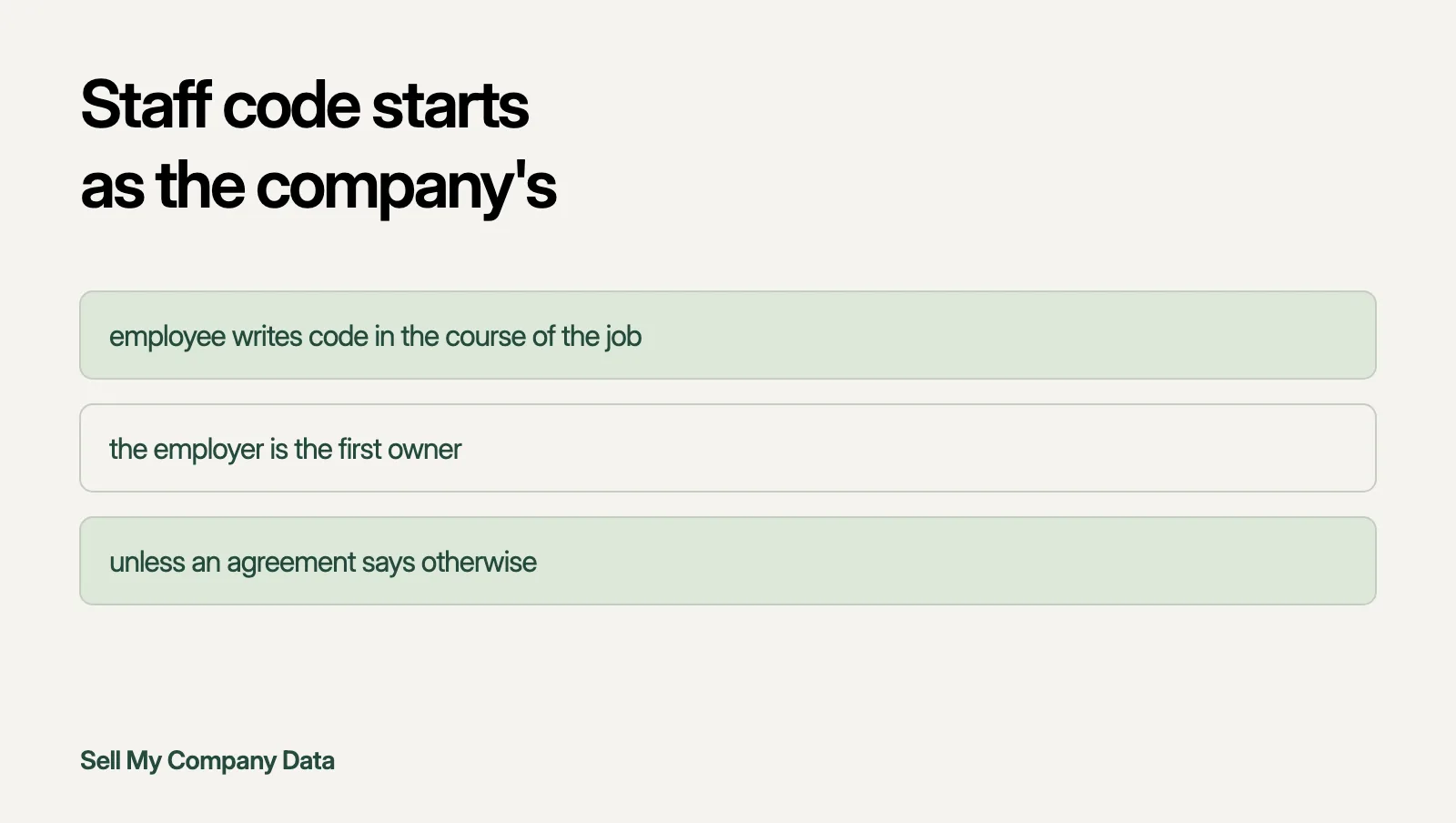
Code counts as a written work. The Act lists a computer program among literary works, so ordinary copyright rules apply to it.
The default rule is that the writer owns the work. The first ownership rule says the author of a work is the first owner of any copyright in it. The employee exception follows: where a work is made by an employee in the course of employment, the employer is the first owner, unless an agreement says otherwise.
So staff code is usually the company's to offer. Two words carry the weight: employee and in the course of employment. A founder's weekend side project, or code written before the company existed, may fall outside both.
Contractor code needs a signed assignment
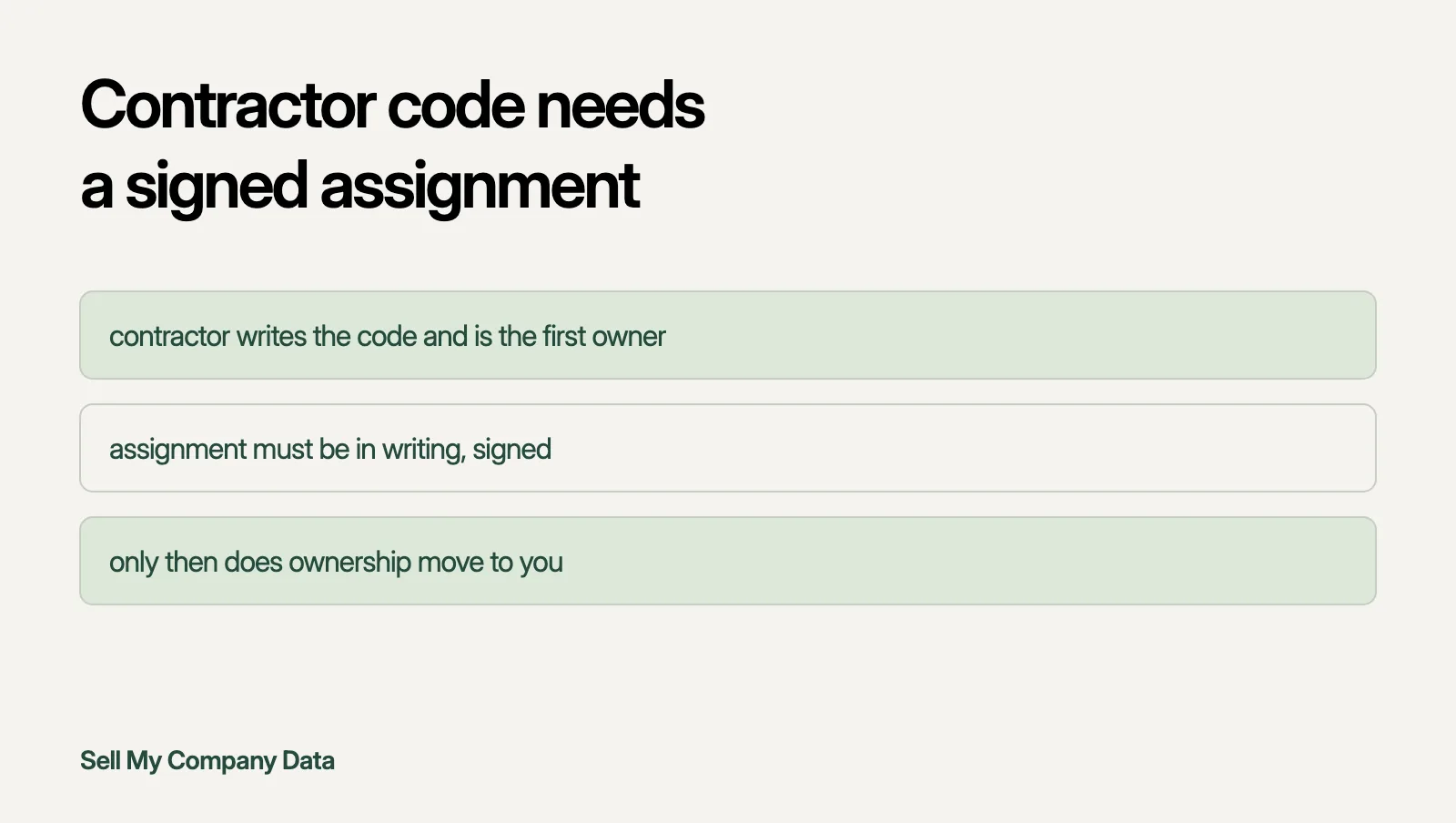
A freelancer or agency is not an employee. The default rule applies: the author owns the copyright. A contract that says you own the output helps only if it assigns the rights.
The assignment rule is specific about form. An assignment of copyright is not effective unless it is in writing signed by or on behalf of the assignor. An email thread saying the work is yours may not meet that test. A licence is a separate thing again, and it may be narrower than you assume.
This is the most common gap in small software companies. The code runs the product and is described as the company's, yet the paperwork for part of it was never signed.
Authorship map
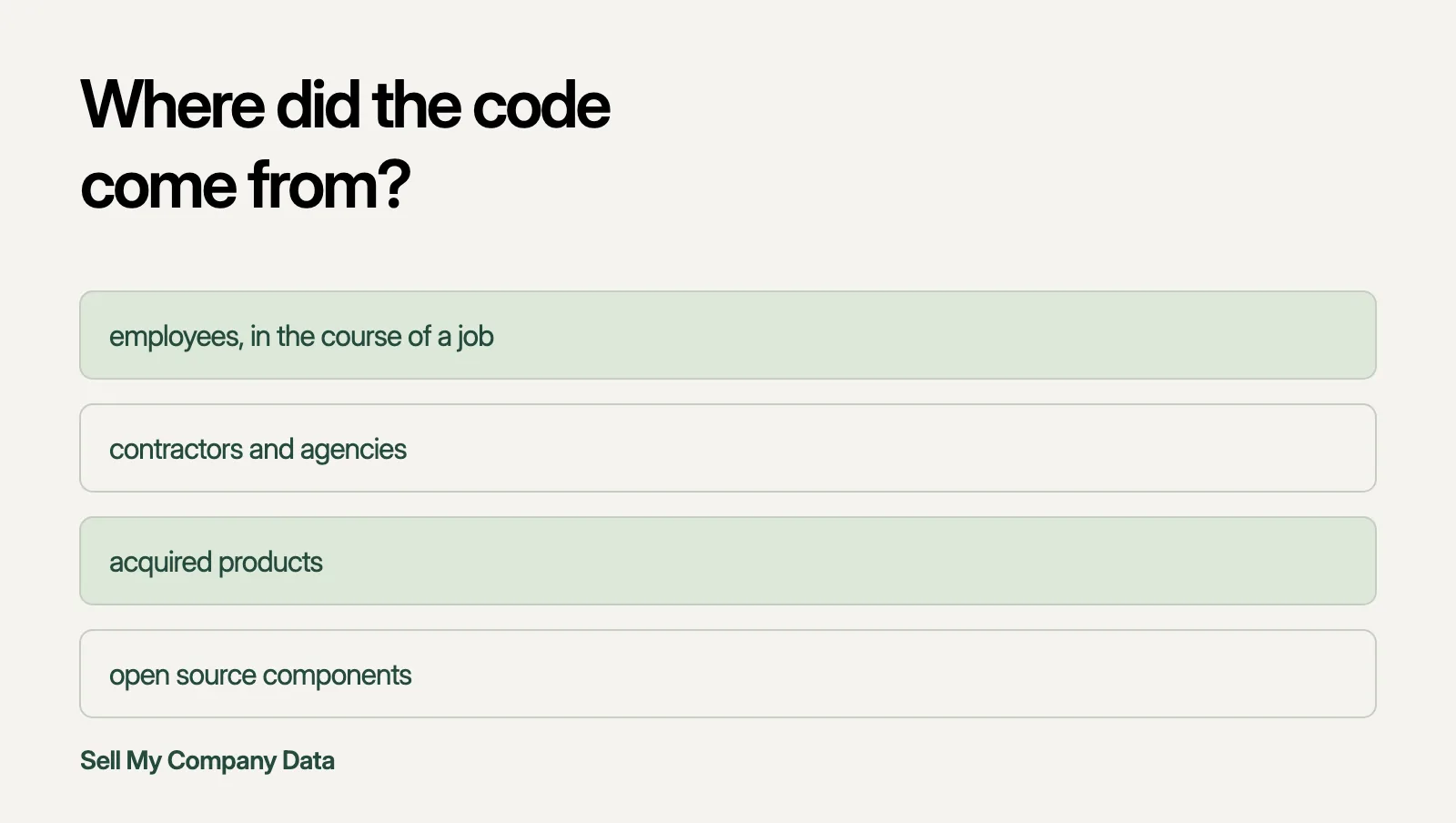
| Where the code came from | Who likely owns it | Proof to gather |
|---|---|---|
| Employees, in their jobs | The company, unless a contract says otherwise | Employment contracts and role descriptions |
| Contractors and agencies | The author, until assigned in a signed document | The signed assignment or a written licence |
| Acquired company or product | Whoever the purchase agreement assigned it to | The agreement and any assignments it refers to |
| Open source components | The original authors, under their licence terms | A list of components and their licences |
What to assemble before a buyer asks
Do not start with the code. Start with a short ownership file a buyer can read in minutes.
- List every repository and the years it was active.
- For each, list who committed: staff, contractors, agencies.
- Match each contractor to a signed assignment. Mark the gaps plainly.
- List third party and open source components with their licence names.
- Note anything excluded: customer data in test fixtures, credentials, secrets and personal data.
A repository with unresolved authorship can still be described honestly as partly cleared. It cannot be described as fully owned. If a gap matters, get a solicitor to review the assignment position before any conversation about a licence. This guide is general information, not legal advice.
Remove secrets and personal data from history before anyone sees a sample. Keys committed years ago are still in the history.
Describe the codebase, do not send it
The first message to a buyer is a description. Name the languages, the rough size, the years of history and whether commit messages and review comments survive. Say what proportion of authorship is documented as company owned, in words you can back up.
History is often worth more than the final snapshot, because commit messages and reviews record why a change was made. That depends on the history being intact, so check it before any migration or tidy up squashes it.
Sources
- Copyright, Designs and Patents Act 1988, section 11 (legislation.gov.uk). Checked 2 November 2026. Relevant text: The author of a work is the first owner of any copyright in it
- Copyright, Designs and Patents Act 1988, section 90 (legislation.gov.uk). Checked 2 November 2026. Relevant text: An assignment of copyright is not effective unless it is in writing signed by or on behalf of the assignor
- Copyright, Designs and Patents Act 1988, section 3 (legislation.gov.uk). Checked 2 November 2026. Relevant text: a computer program
Questions
Does the company own code its employees wrote?
Usually yes. Where an employee makes a work in the course of employment, the employer is the first owner unless an agreement says otherwise. Work outside the job, or before the company existed, needs checking separately.
Do we own code written by a freelancer?
Not automatically. The author is the first owner. Ownership moves to you through a written assignment signed by the freelancer. A licence may give you use of the code without ownership.
Can we license code that includes open source parts?
The open source parts stay under their own licences. List them separately and describe only the code you can show you own.
Should I send a sample of the repository first?
No. Send an ownership description. Samples come later, after secrets and personal data are removed and the authorship position is clear.
Is this legal advice?
No. It is general information about how UK copyright ownership works. Have a solicitor review any ownership gap before you rely on it.