
Healthcare admin data licensing: health clues
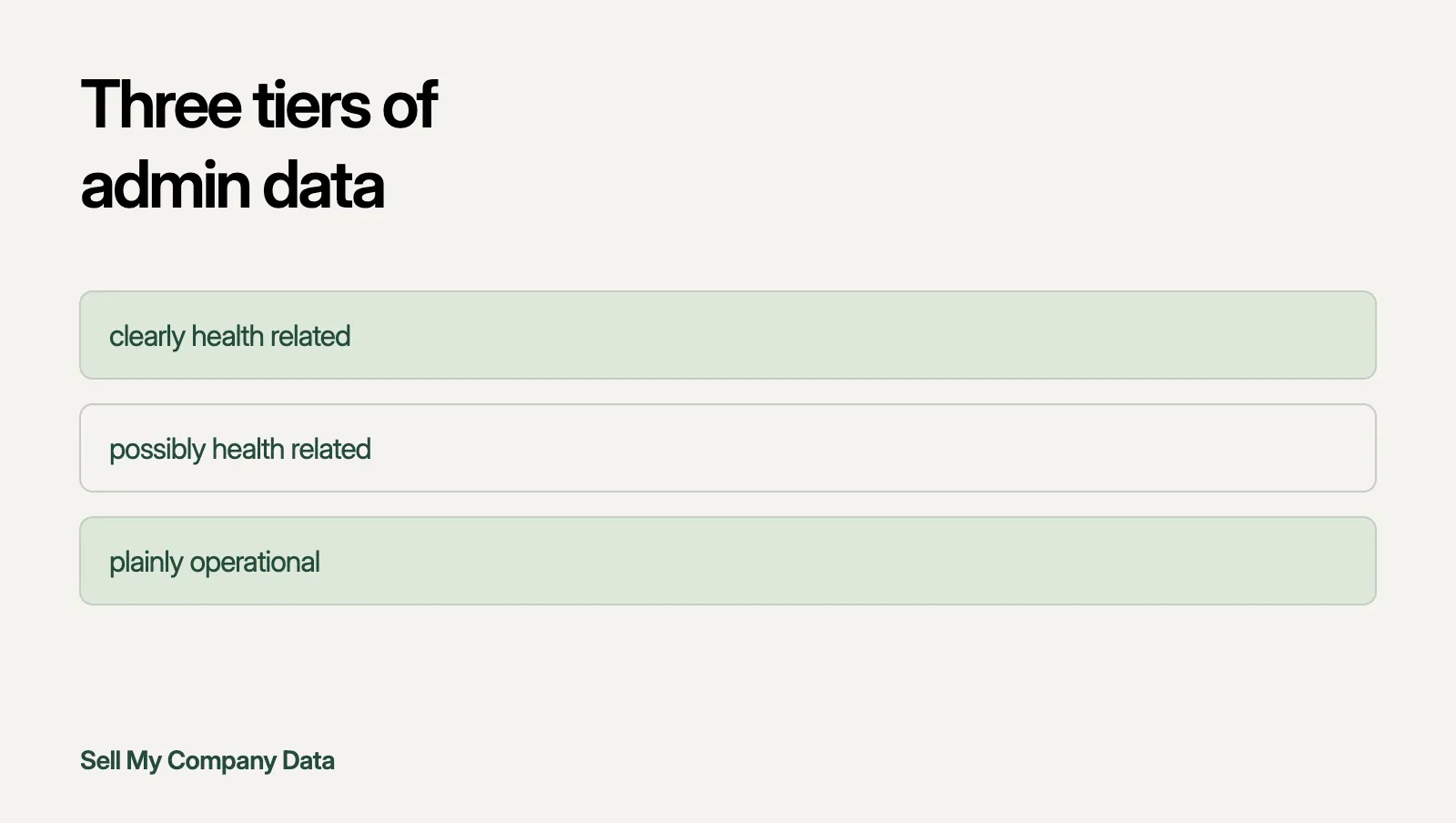
Healthcare admin data is not safe just because it holds no clinical notes. Appointment, referral, billing and rota records can still reveal who is a patient and why. The law treats information about a person's health status as special category data. Classify each field as clearly health related, possibly health related or plainly operational, and offer only the last group.
By Sell My Company DataPublished 15 November 2026
No files needed to start
- Sources
- 4 primary sources
- Reading time
- About 3 min
- What this adds
- A field classification table for healthcare admin exports. It sorts the usual admin data classes into three tiers, names the question to ask for each and says what to leave out of a first buyer description.
Admin data can still describe a patient
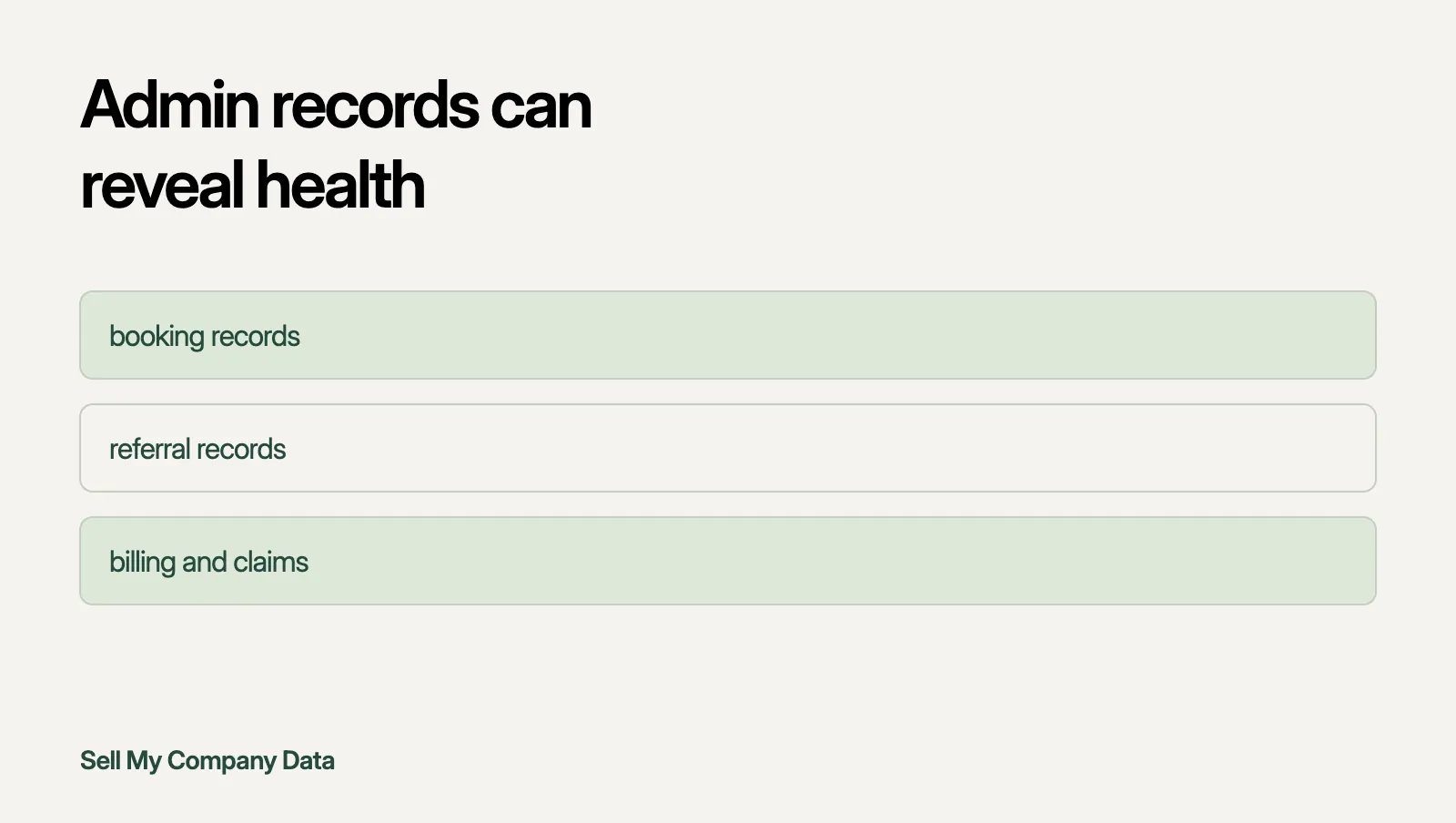
A clinic or care provider holds two kinds of records. Clinical notes are obviously sensitive. Admin records look harmless: bookings, referrals, invoices, room use and staff rotas. The test in law is not the label on the system. UK GDPR defines data concerning health as personal data related to the physical or mental health of a natural person. An appointment with a named oncology clinic, a referral code or a prescription invoice can fit that definition without a single clinical note.
So the first question about a healthcare admin export is not what it is called. It is whether any field, alone or next to another, says something about a person's health or care.
Health status is special category data
Health information gets stronger protection than ordinary personal data. Processing it is prohibited unless a listed condition applies. One condition is that the data subject has given explicit consent to the processing of those personal data for one or more specified purposes. Others cover care delivery and public health, and none of them is a general permission to sell an archive.
A provider that collected booking data to run appointments did so for that purpose. The purpose limitation principle asks for data collected for specified, explicit and legitimate purposes, not used later in a way that conflicts with them. Licensing a patient list for model training is a new purpose. Do not assume the original notice covered it. Read what patients were actually told.
The CRM and support ticket guides on this site explain the notice duties in more detail for other record types.
Field classification: three tiers of admin data
Go through the export field by field. The table sorts common healthcare admin classes into three tiers. This is a working method, not a legal ruling, so any field you cannot place goes up a tier.
| Admin data class | Tier | Question to ask |
|---|---|---|
| Appointment and referral records with patient identifiers | Clearly health related | Leave out unless a solicitor confirms a lawful route |
| Billing and insurance claims | Clearly health related | Does any line name a treatment or provider type |
| Complaint and incident logs | Possibly health related | Do free text fields mention conditions or names |
| Waiting list and no-show statistics | Possibly health related | Is it aggregated enough that no person can be picked out |
| Staff rotas and shift patterns | Personal data | Are employees named, and did their terms allow this use |
| Room use, equipment and stock levels | Plainly operational | Does it link to any patient record |
| Supplier and procurement records | Plainly operational | Check the supplier confidentiality terms |
Most buyers of operational data want the last two rows. Those are the classes most likely to be offered safely, and only after the contract check.
Removing names does not end the risk
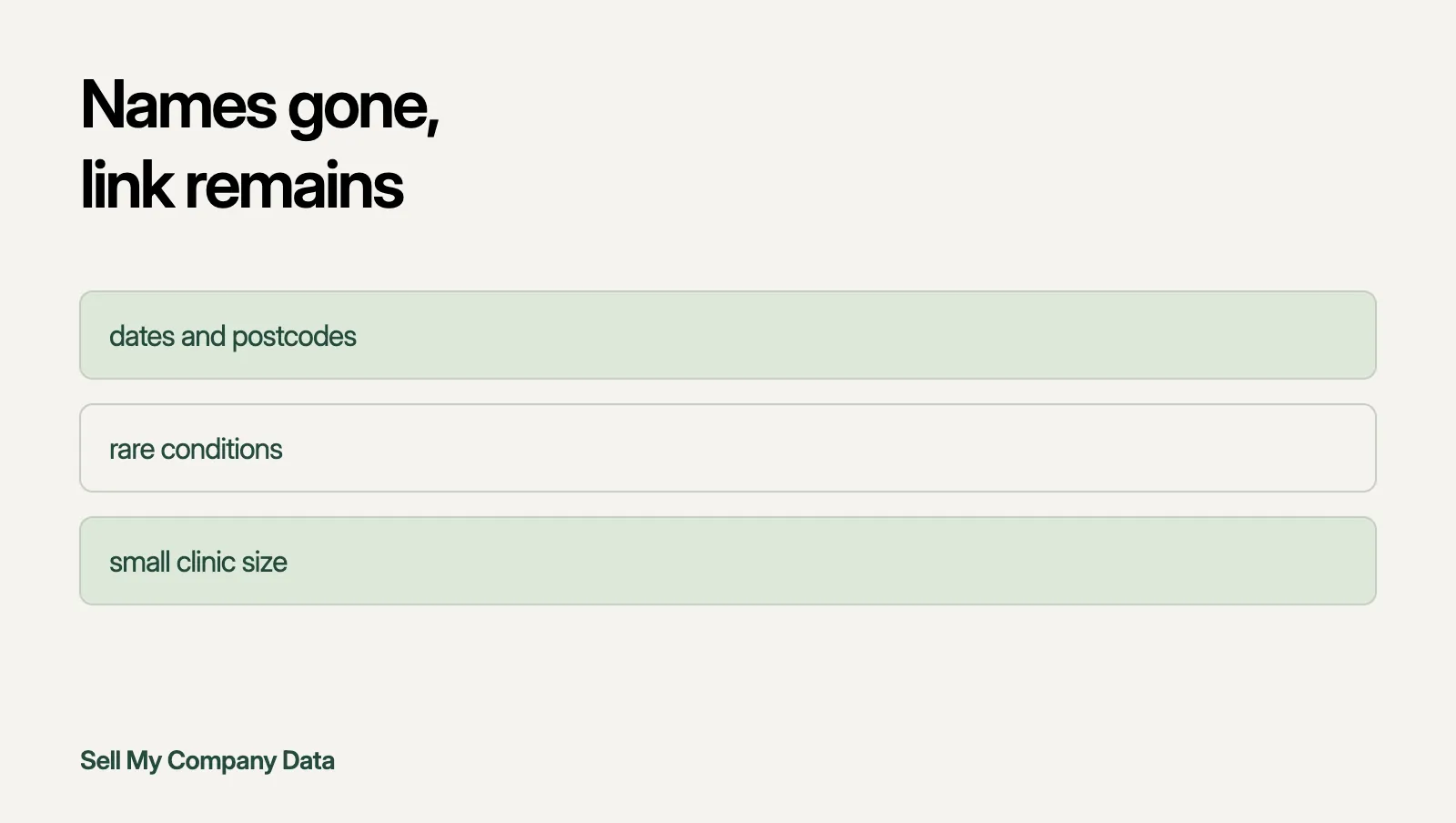
Sellers often propose to strip names and sell what is left. That is a start, not a clearance. Dates, postcodes, rare conditions and small clinic sizes can point back to one person. The Data Protection Act 2018 makes one act a crime. It is an offence for a person knowingly or recklessly to re-identify information that is de-identified personal data without the consent of the controller responsible for de-identifying the personal data.
That offence targets the person who re-identifies. It does not tell you your own export is anonymous. If a buyer could reasonably link records back to people, treat the export as personal data and keep it out of a first description.
Write down how you tested for re-identification: which fields you removed, which you generalised and who reviewed the result. A careful buyer will ask for that note.
What a safe first description contains
Describe the operational classes only. Give the type of provider, the years covered and the data classes present, such as room use or stock levels. Say which classes were left out and why.
Do not send a sample. Do not send a booking extract to prove quality, even with names removed. Keep the field classification table, the notice wording you checked and the decision for each class in one file.
If a class sits in the first or second tier of the table, that is a question for a solicitor before anything is described to a buyer.
Sources
- UK GDPR, Article 4 (legislation.gov.uk). Checked 15 November 2026. Relevant text: personal data related to the physical or mental health of a natural person
- UK GDPR, Article 9 (legislation.gov.uk). Checked 15 November 2026. Relevant text: the data subject has given explicit consent to the processing of those personal data for one or more specified purposes
- UK GDPR, Article 5 (legislation.gov.uk). Checked 15 November 2026. Relevant text: for specified, explicit and legitimate purposes
- Data Protection Act 2018, section 171 (legislation.gov.uk). Checked 15 November 2026. Relevant text: It is an offence for a person knowingly or recklessly to re-identify information that is de-identified personal data without the consent of the controller responsible for de-identifying the personal data
Questions
Is healthcare admin data health data?
It can be. UK GDPR covers personal data that reveals information about a person's health status, so appointment, referral and billing records can qualify even without clinical notes.
Can I sell patient lists if I remove the names?
Not safely on that basis alone. Dates, postcodes and rare conditions can identify a person. Treat the export as personal data until a review shows nobody could reasonably be picked out.
Which healthcare admin data can be offered first?
Room use, equipment and stock levels that do not link to any patient record are the usual candidates. Supplier terms still need checking.
Does the original patient notice cover licensing?
Do not assume so. Data collected to run care was collected for that purpose. Read the notice patients actually saw and ask a solicitor whether a new purpose is covered.
Is this legal advice?
No. It is general information about UK law. Have a solicitor review your notices and the export before you rely on it.