
HR and employee data licensing: start with the people
HR and employee data is the hardest company data to license, because every record is about a named worker. Employers hold it to run employment, not to sell it. Sort each record type into leave out, mixed or aggregate only, then describe only what is left. Never share sample files or exports with a buyer.
By Sell My Company DataPublished 17 November 2026
No files needed to start
- Sources
- 4 primary sources
- Reading time
- About 3 min
- What this adds
- An HR record sorting table. It takes the record types the ICO lists for employers and gives each one a call: leave out, mixed, or aggregate only, with the question to ask first.
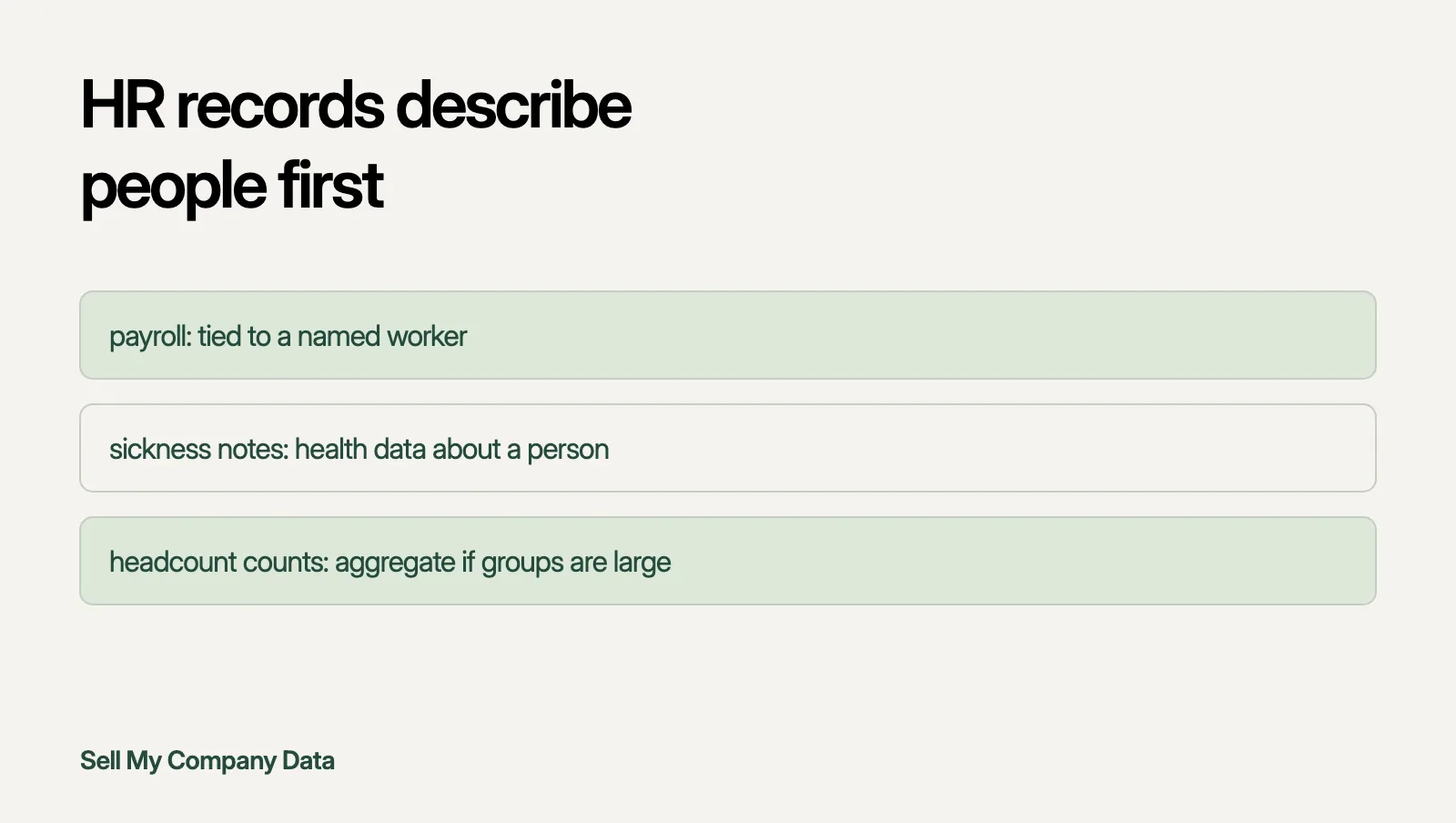
HR data is personal data about your own staff
Most data guides start with who owns the data. For HR data the first question is different: whose information is it? Payroll, reviews and absence records describe workers. Your company holds them to employ people, not to resell them.
That does not make every HR figure off limits. A headcount trend with no names is a different thing from a payroll export. The work is separating the two, record type by record type, before anyone outside the company hears a description.
What an HR system actually holds
The ICO lists the records an employer may keep. They include personnel files; sickness and injury records; disciplinary and grievance records, plus payroll, pension, appraisal and equality records. Most HR platforms hold several of these side by side.
The same page makes the legal point plainly. The UK GDPR and the DPA 2018 apply whenever you are processing your workers' personal information. A sale or licence is a new use, so it has to be checked against those rules as a use of its own, not as part of running payroll.
Two features make HR data riskier than most. Some of it is special category data. Processing of personal data revealing racial or ethnic origin is prohibited unless a listed condition applies. Health data and trade union membership are on the same list. Equality forms and sickness notes sit in that territory.
The other feature is consent. The ICO notes that consent provides certain difficulties in an employment context. Do not assume a staff handbook line or a contract clause settles it. Take advice before relying on any consent for a new use.
Collected to employ people, not to sell
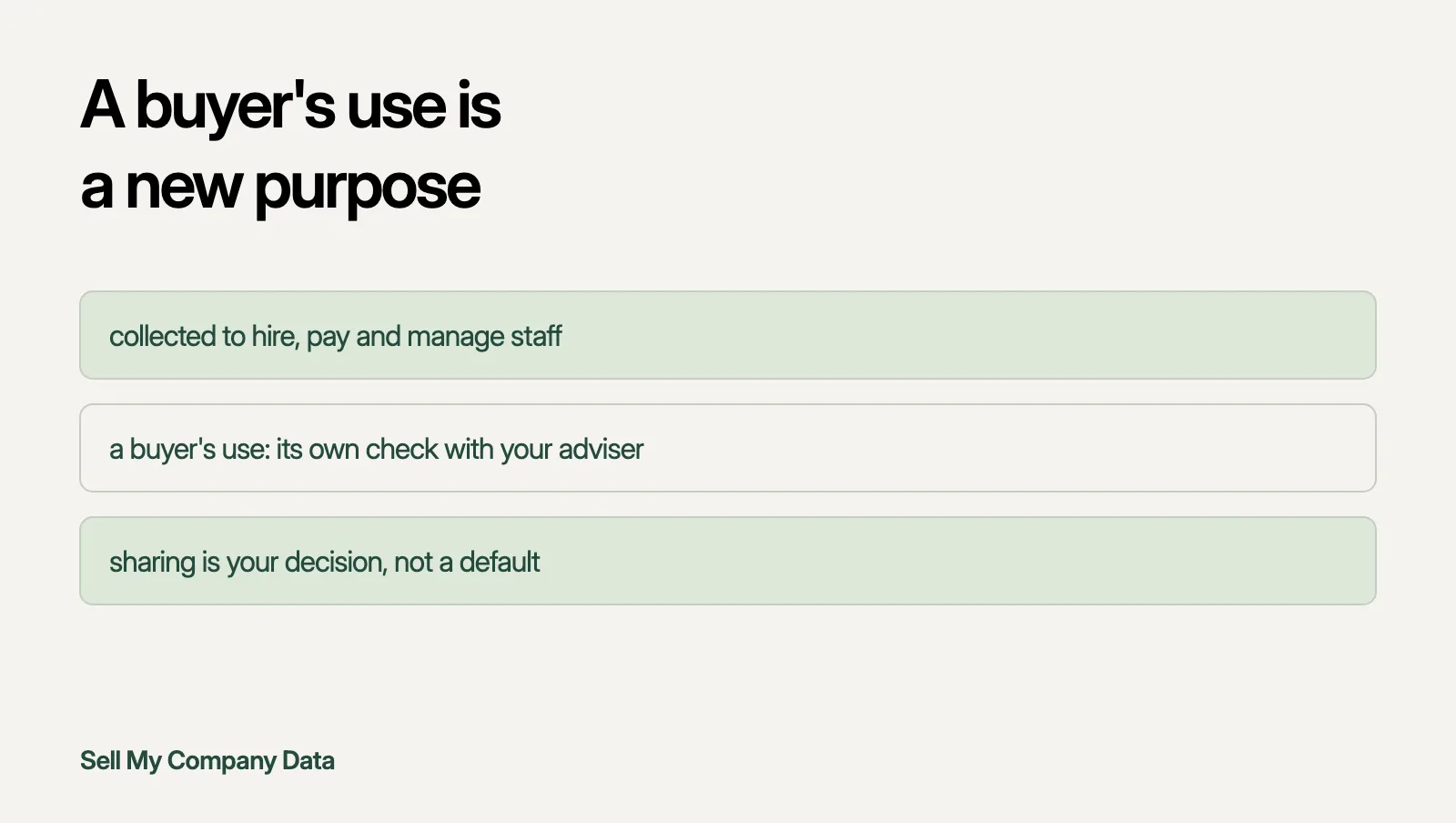
Data protection law ties data to the reason it was collected. Under Article 5, data must be adequate, relevant and limited to what is necessary in relation to the purposes for which they are processed. It must also be collected for specified, explicit and legitimate purposes. Staff gave details so you could hire, pay and manage them.
A buyer's use is a different purpose. Whether it is compatible is a legal question for your adviser, not something a data room description can answer. This site does not give that clearance.
Sharing has its own test. The ICO says that you do not need to share information about your workers just because someone has asked for it. A buyer asking for HR data is the same kind of request. You decide, with advice, whether sharing is right. Silence from staff is not a yes.
HR record sorting table: one call per record type
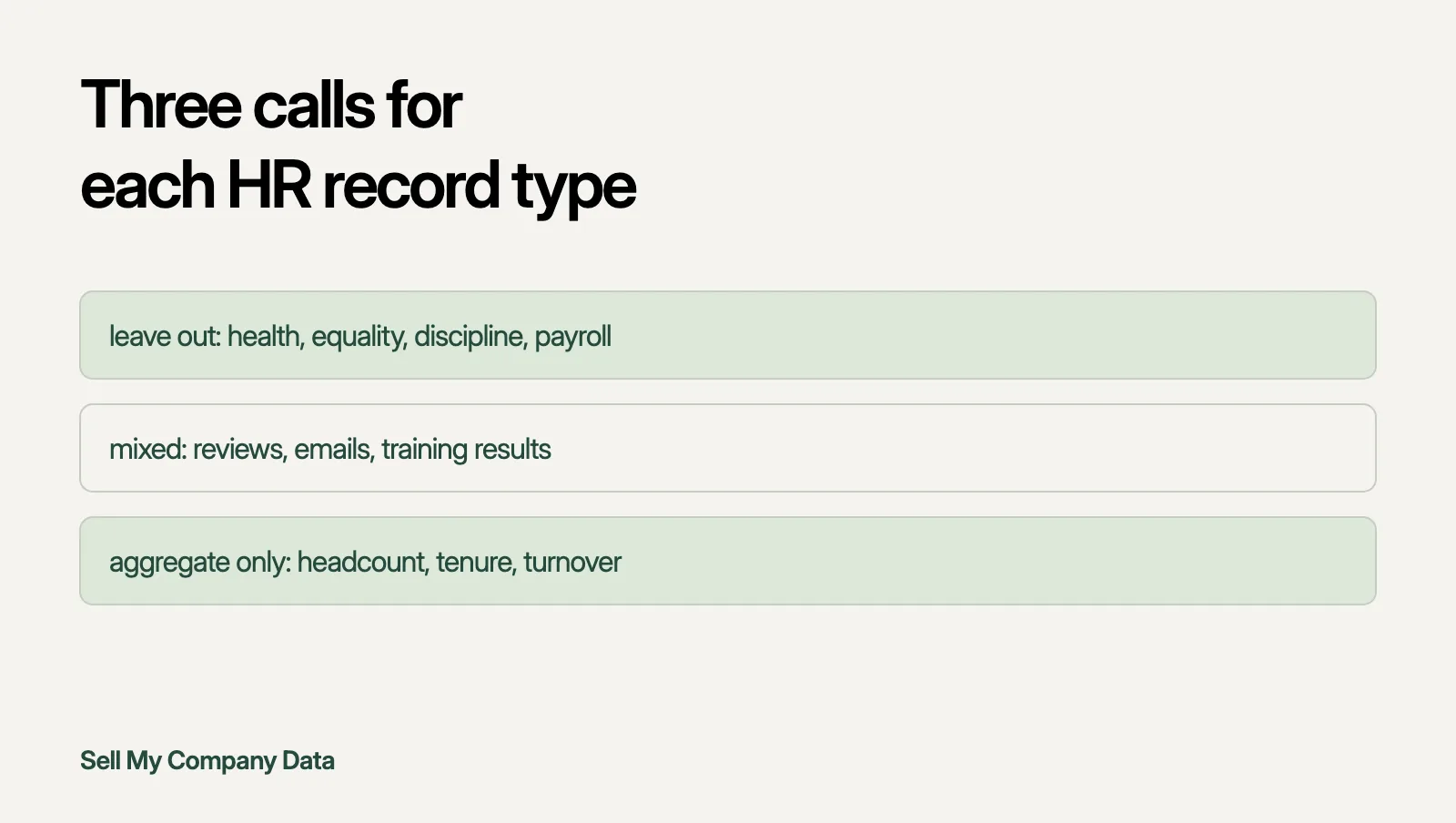
Work through one record type at a time. This is a working method, not a legal ruling. A type you cannot place moves up a group.
| Record type | Call | Question to ask first |
|---|---|---|
| Sickness, injury and occupational health records | Leave out | Is this health data about a named person |
| Equality and diversity forms | Leave out | Does it reveal origin, belief, health or sexual orientation |
| Disciplinary and grievance records | Leave out | Does it name the worker or a colleague |
| Payroll and pension records | Leave out | Could one worker be picked out from the fields |
| Appraisals, interview notes and references | Mixed | Does the text carry names, opinions or third party detail |
| Staff emails | Mixed | Is the content about people, and who else wrote in the thread |
| Training completion and course content | Mixed | Are results tied to named workers, or is the content generic |
| Headcount, tenure and turnover counts | Aggregate only | Are groups large enough that no one can be picked out |
Write the call and the reason for each record type in one file. A buyer will ask how you decided. So will your adviser. Treat anything in the leave out group as unavailable, however much interest it draws.
What a safe first description contains
Describe the aggregate group only. Give the system, the date range, the kinds of counts you could provide and the sorting file you kept. Say which record types you left out and why.
Do not send sample records, exports or screenshots. One HR screen can show a name, a salary and a sickness note at once. A sample is a disclosure, so keep the sorting file instead.
The rights checklist covers the wider evidence a buyer will want. The healthcare admin guide covers another people-heavy record set. The email archive guide covers the mailboxes that often hold HR threads.
Sources
- Collecting and keeping employment records (ICO). Checked 17 November 2026. Relevant text: The UK GDPR and the DPA 2018 (referred to here as data protection law) apply whenever you are processing your workers' personal information.
- Using employment records (ICO). Checked 17 November 2026. Relevant text: You do not need to share information about your workers just because someone has asked for it.
- UK GDPR Article 5 (legislation.gov.uk). Checked 17 November 2026. Relevant text: adequate, relevant and limited to what is necessary in relation to the purposes for which they are processed
- UK GDPR Article 9 (legislation.gov.uk). Checked 17 November 2026. Relevant text: Processing of personal data revealing racial or ethnic origin
Questions
Can a company license its employee data?
Rarely in raw form. Employee records are personal data about named workers, collected to run employment. Some are special category data. Counts that cannot point to one person are a safer starting point. Take legal advice before offering even those.
Is anonymised HR data safe to offer?
Not automatically. Removing names does not help if a job title, team and start date still point to one worker. Test each count for that before you describe it. Keep the test in your sorting file.
Do staff need to agree before HR data is shared?
Do not assume so, and do not assume consent works. The ICO says consent provides certain difficulties in an employment context. Ask your adviser which basis, if any, could support a new use.
What can I tell a buyer first?
Describe aggregate counts only, with the system, the date range and the checks you ran. State which record types you left out. Never send sample records.