
Law firm data licensing: privilege first
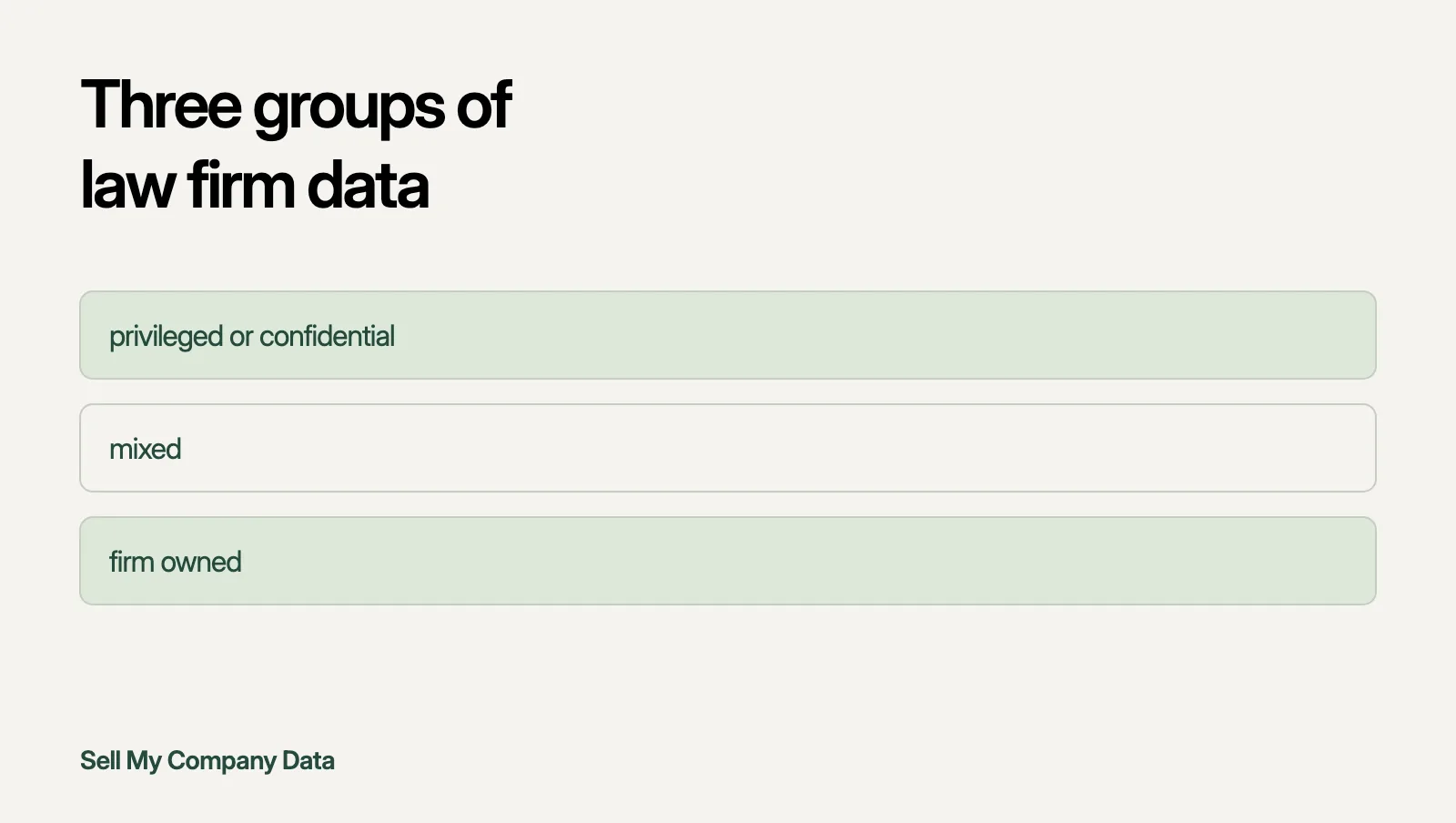
A law firm cannot license data just because it holds it. Client files and advice sit under legal professional privilege and a duty of confidentiality owed to the client. Firm owned material, such as precedents written by employed lawyers, is the stronger starting point. Sort every data class into privileged, mixed or firm owned. Describe only the last group to a buyer.
By Sell My Company DataPublished 16 November 2026
No files needed to start
- Sources
- 4 primary sources
- Reading time
- About 4 min
- What this adds
- A sorting table for law firm exports. It places each data class in one of three groups, names the question to ask and says what to leave out of a first buyer description.
A law firm holds data it does not own
A firm's systems hold two kinds of material. Some is the firm's own: templates, checklists, training decks and management figures. The rest exists because a client instructed the firm: files, advice, correspondence and the billing entries that describe the work. Holding the second kind does not make it the firm's to license.
The law marks the line in two places. Privileged information gets special treatment under the Data Protection Act 2018. Copyright decides who owns what the firm's lawyers wrote. Both are covered below. Neither is a clearance for a sale.
Privilege and confidentiality stay with the client
The Data Protection Act 2018 has an exemption for legal professional privilege. Under it, the listed GDPR provisions do not apply to personal data in two cases. One is information where a privilege claim could be maintained. The other is information in respect of which a duty of confidentiality is owed by a professional legal adviser to a client of the adviser.
Read that carefully. It switches off certain data protection duties for privileged material, such as some rights of access. It does not turn privileged material into licensable inventory. The second case shows where the duty sits. It is owed to the client, so the firm is the holder, not the owner.
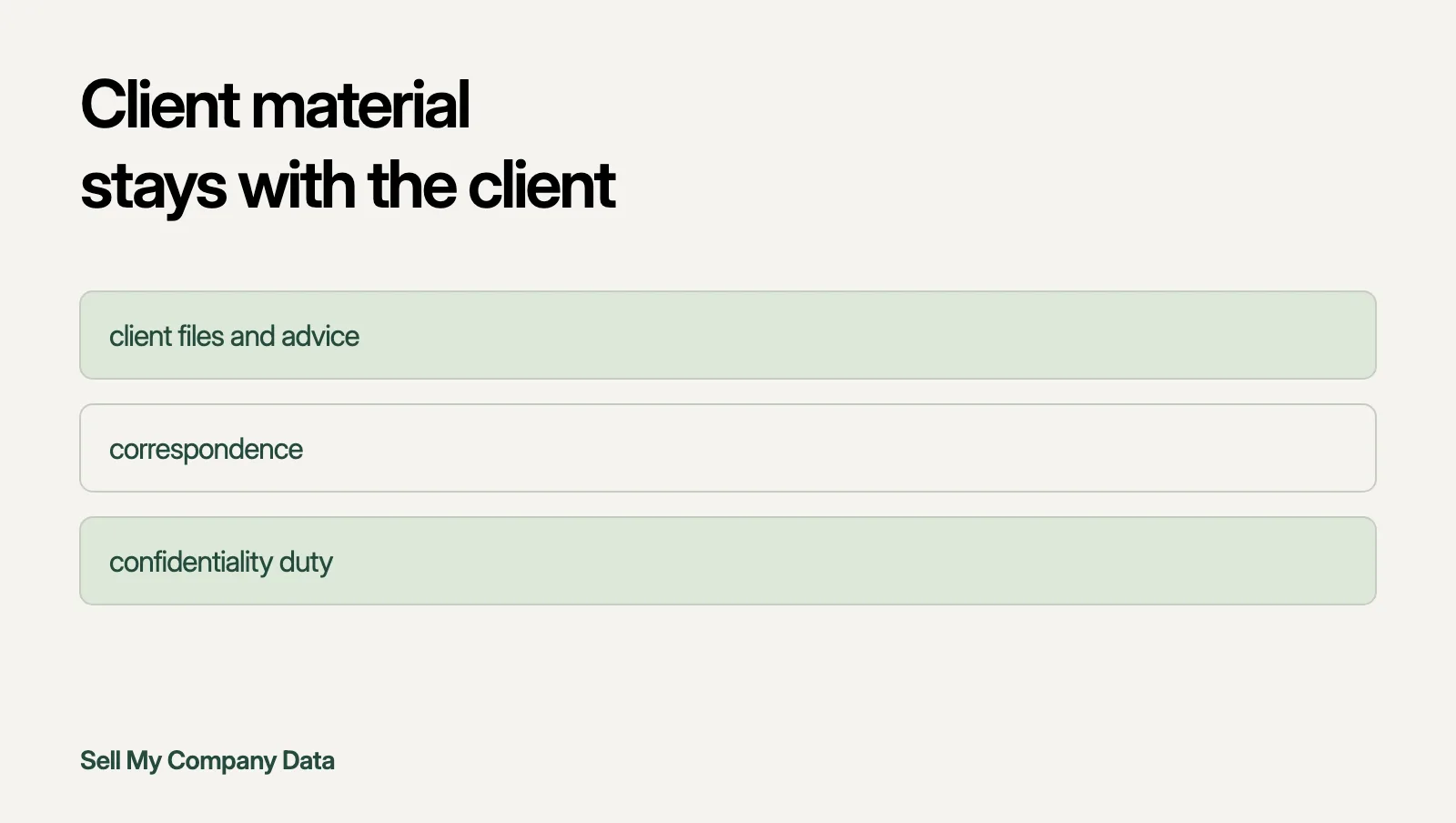
The practical result is simple. Client files, advice and anything the firm holds because a client instructed it belong in the first group of the table below. Keep them out of a buyer description unless the client and your regulator's rules allow it. Check your regulator's current guidance directly, because this site does not summarise it.
Employee written precedents are the firm's starting point
The strongest candidates are documents the firm authored. Under the Copyright, Designs and Patents Act 1988, the author of a work is the first owner of any copyright in it. Employees are an exception. Where a work is made in the course of employment, his employer is the first owner of any copyright in the work subject to any agreement to the contrary.
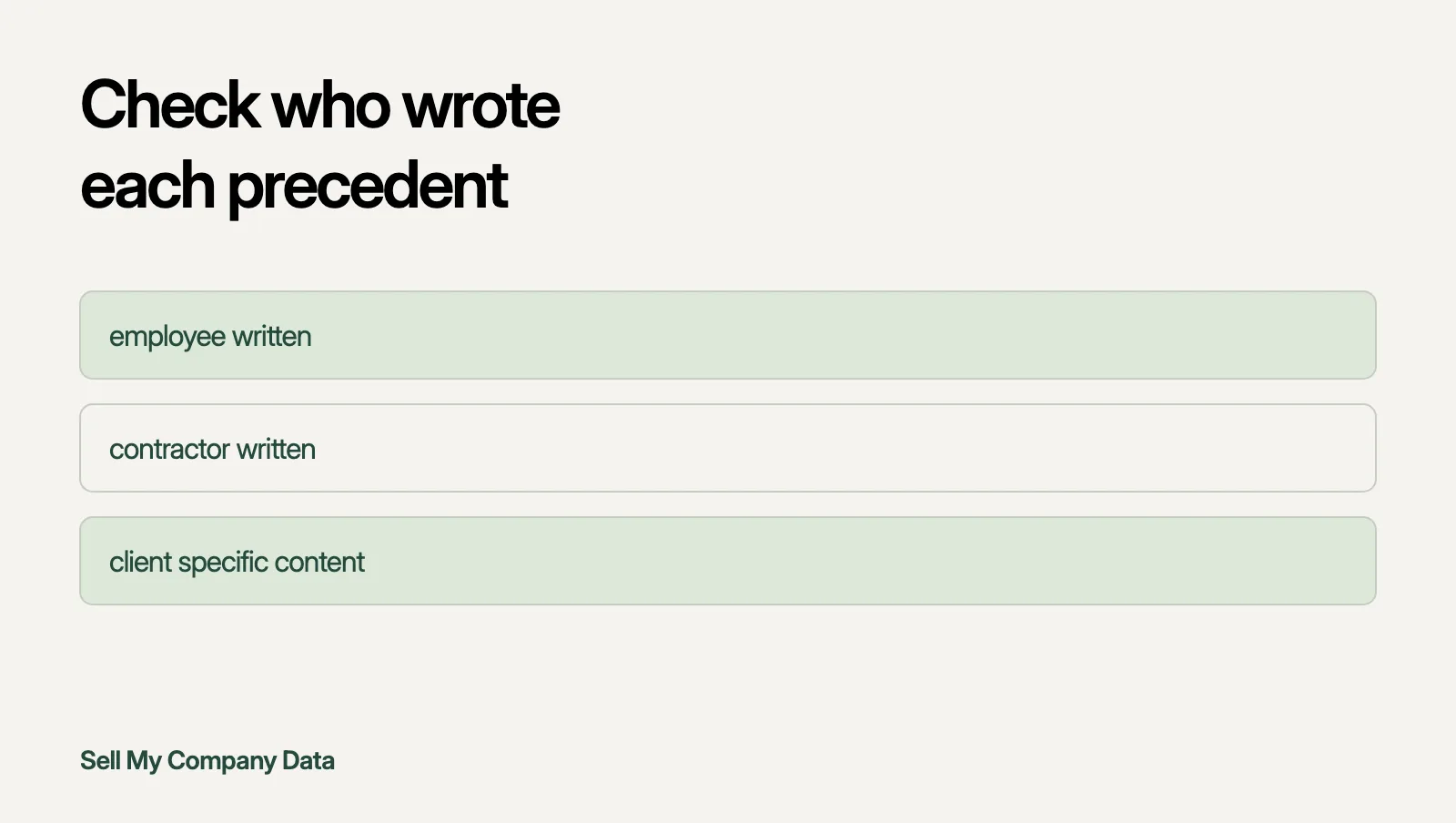
So a precedent bank written by employed lawyers usually starts as firm owned. A template drafted by a contractor, a consultant or counsel instructed separately needs its own check, because the author may be the first owner. Look at the engagement terms for each.
A licence is a separate step. An assignment of copyright is not effective unless it is in writing signed by or on behalf of the assignor. Any buyer will expect written terms for what is granted and for how long. Do not describe rights you have not confirmed.
Precedents also drift. A template that started generic may now hold a client name, a deal term or a clause negotiated for one client. Treat any such document as mixed until it is cleaned.
Sorting table: what each data class needs
Go through the export class by class. This is a working method, not a legal ruling, so any class you cannot place moves up a group.
| Data class | Group | Question to ask |
|---|---|---|
| Client files, advice and correspondence | Privileged or confidential | Leave out unless the client and your regulator's rules allow it |
| Billing narratives and time entries | Mixed | Do entries name clients, opponents or matter details |
| Matter lists and fee arrangements | Mixed | Can a client or matter be identified from the description alone |
| Conflicts and intake records | Mixed | Do they hold names of prospective clients or other parties |
| Precedent banks and templates by employed lawyers | Firm owned, check | Does any document still carry client specific content |
| Know-how notes and training decks | Firm owned, check | Were they written for a client or only for internal use |
| Practice management figures with no client link | Firm owned | Is any figure small enough to point to one client |
Most buyer interest starts in the middle rows, which is exactly where the cleaning work sits. Treat a mixed class as unavailable until that work is done and recorded.
What a safe first description contains
Describe the firm owned classes only. Give the practice areas, the years covered and the document types, such as templates or internal training material. Say which classes were left out and why.
Do not send a sample. A single billing entry or precedent can carry a client name, so a proof of quality is itself a disclosure. Keep the sorted table, the authorship check for each precedent set and the decision for every class in one file.
Data minimisation applies to any personal data left in what you offer. The UK GDPR asks for data that is adequate, relevant and limited to what is necessary in relation to the purposes for which they are processed. If a field is not needed for the stated purpose, remove it first.
The CRM contact guide and the rights checklist cover the notice and ownership checks in more detail.
Sources
- Data Protection Act 2018, Schedule 2 paragraph 19 (legislation.gov.uk). Checked 16 November 2026. Relevant text: information in respect of which a duty of confidentiality is owed by a professional legal adviser to a client of the adviser
- Copyright, Designs and Patents Act 1988, section 11 (legislation.gov.uk). Checked 16 November 2026. Relevant text: his employer is the first owner of any copyright in the work subject to any agreement to the contrary
- Copyright, Designs and Patents Act 1988, section 90 (legislation.gov.uk). Checked 16 November 2026. Relevant text: An assignment of copyright is not effective unless it is in writing
- UK GDPR, Article 5 (legislation.gov.uk). Checked 16 November 2026. Relevant text: adequate, relevant and limited to what is necessary in relation to the purposes for which they are processed
Questions
Can a law firm sell client files?
Not on the firm's own say. Client files and advice are privileged or confidential. The duty of confidentiality is owed to the client. Plan around them unless the client and your regulator's rules allow a specific use.
Does the privilege exemption let a firm license privileged data?
No. The Data Protection Act 2018 exemption disapplies listed data protection provisions for privileged information. It does not give the firm a right to license that information.
Who owns the firm's precedent bank?
Often the firm, where the documents were made by employees in the course of employment and there is no agreement to the contrary. Work by contractors or separately instructed counsel needs its own check.
Are billing narratives safe to offer?
Not by default. They often name clients, opponents or matter details, so treat them as mixed until a review shows no person or matter can be picked out.
Is this legal advice?
No. It is general information about UK law. Have a solicitor and your regulator's guidance reviewed before you rely on any step.